Cyclones from the Bay of Bengal frequently lash the eastern parts of India, destroying life and property. The Indian Meteorological Department defines eight categories of wind speed. The first three categories have low wind speed and, therefore, do not develop into cyclones. They constitute more than seventy percent of the cases. The next three categories constitute less than twenty percent of the cases. In these cases, there is increasing severity of cyclones. The last two categories constitute less than one percent of the cases but create havoc on the east coast of India. If we could know the severity of a cyclone in advance, many lives could be saved.
Is there a way to improve the prediction of cyclone severity?
Recently, four researchers from different institutions on the east coast tackled the question. To do so, they began by identifying major limitations in existing methods of predicting the severity of cyclones.
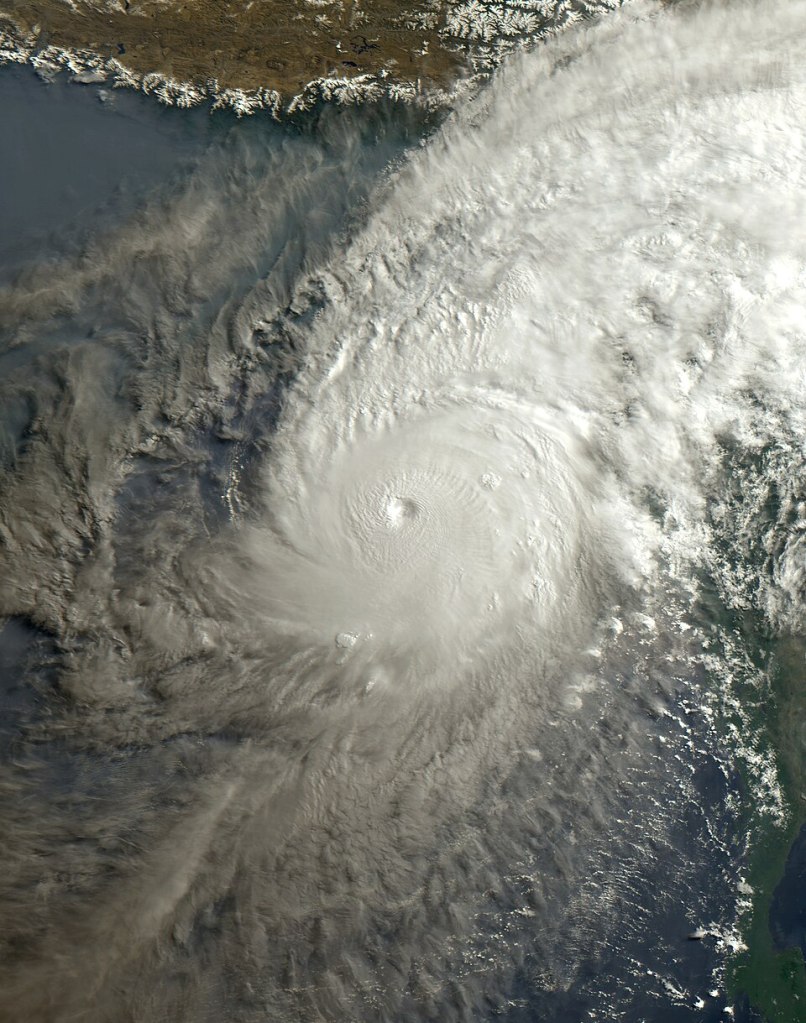
Existing methods collect data about these features from remote sensing satellites. They also consider land- and sea-based meteorological features. To predict cyclones, certain features are taken into consideration. Some features that impact cyclone intensification are local. Some features are not local and need to be extracted from a much wider area. Some features, such as precipitation, are discrete. For example, in the eye of the cyclone, there i not much precipitation. The area under the arms of the cyclone tend to have heavy rain.
Image: cyclone Mocha from JMA’s Himawari 9 Satellite via Wikimedia Commons
Other features, such as sea surface temperature, tend to vary in a continuous manner. These differences between features are not taken into consideration in existing methods.
To overcome the challenges posed by the diversity of the features and their characteristics, the researchers decided to separate discrete and continuous features into groups, based on their similarities. Thus, eight features were divided into six groups for separate processing.
From the European Centre for Medium-Range Weather Forecasts, the researchers collected reanalysis data on the features for the period between 2002 and 2021. They investigated the similarity between pairs of features and, based on the similarities, they grouped the features into categories. Since computation is costly when features are processed separately, the researchers pooled the data about the categories, ensuring that information significant to intensification was preserved.
To understand the trajectories of previous cyclones, they collected data on the paths of cyclones in the Bay of Bengal from the International Best Track Archive for Climate Stewardship.
For cyclone classification, the researchers created SGANet, a multi-branch local-global convolutional neural network. To train SGANet, they used the grouped and pooled data.
The dataset used for training contained data on 4000 events related to the various categories of the Indian Meteorological Department (IMD). Since severe cyclones are fewer than not so severe cyclones, the researchers had to balance the dataset for training the model. To balance the dataset, they made minor changes in the data of more severe cyclones and accordingly augmented the dataset. The researchers reasoned that minor rotations, changes in brightness or contrast which are physically plausible would not create major errors in the outcome.
To enable the model to learn the local and global structure of cyclones, the researchers used algorithms that pay attention to the data about each channel of the pooled data.
The data input and processing were done in small batches. This helped the researchers extract local spatial features as well global features.
The output was processed and some parts of the output were selectively used to overcome the remaining imbalances in the data related to high intensity cyclones.
The researchers selected the final model with the best validation scores for testing. Their model performed better than the existing models.
Since the model was trained and tested using data from the features of the east coast of India, would it work in other regions?
The researchers extracted the reanalysis data of the west coast of India and the Arabian sea from the European Centre for Medium-Range Weather Forecasts. From the International Best Track Archive for Climate Stewardship, they took data on the paths of cyclones on the west coast and checked their model again. It worked! The predictions about the severity of cyclones were fairly accurate.
The researchers are hopeful that their model will work for predicting the intensities of cyclone in the other parts of the world as well.
Information Sciences, 741: 1-35 (2026);
DOI: 10.1016/j.ins.2026.123258
Reported by Sanghamitra Deobhanj
Freelance science writer, Cuttack


Leave a Reply