For centuries, across South Asia, cooked rice has been soaked and fermented. Not just for taste. People believed that the fermented rice was beneficial to their health.
Soaked in water to ferment, cooked rice is colonized by bacteria. These bacteria can include lactic acid bacteria from the family that produces yoghurt, kimchi and sourdough. Some of these bacteria are probiotics, live microorganisms that provide significant health benefits.
The probiotic bacterial species in fermented rice is influenced by the variety of the rice. Kattuyanam and Mappilai Samba are two rice varieties that have been cultivated in Tamil Nadu for generations. What bacteria flourish in fermented Kattuyanam and Mappillai Samba?
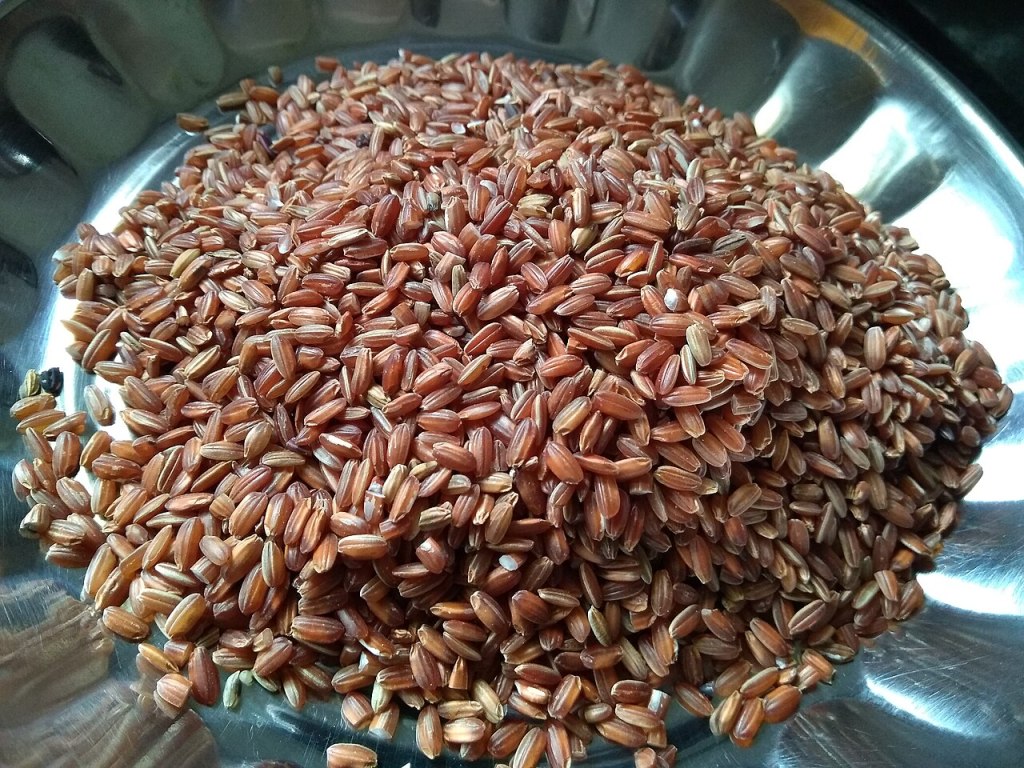
Kattuyanam rice. Image: Thamizhpparithi Maari via Wikimedia Commons
In Chennai, researchers from the Vels Institute of Science and Technology and the Anna Adarsh College for Women decided to find out.
They prepared fermented samples of Kattuyanam and Mappilai Samba and a combination of both. The researchers freeze dried the samples and diluted them for plating on agar medium to allow the bacteria to form colonies. They isolated five distinct colonies from Kattuyanam and four from Mappillai Samba.
Using Gram staining and light microscopy, the researchers found that fermented Kattuyanam had a dominance of Gram-positive yeast cells and cocci, while Mappillai Samba had a balanced mix of Gram-positive rods, cocci, and yeast cells.
To identify the microbes, the researchers sequenced rRNA regions. This metagenomic analysis showed that the most abundant species in Kattuyanam was Liquori Lactobacillus hordei, followed by Lactobacillus ruminis. Mappillai Samba showed similar results with slight variations.
To be considered a probiotic, a bacterium must survive the hard journey through the human gut. It should withstand the acidic environment of the stomach, the bile salts of the small intestine, and adhere to the intestinal lining. The researchers tested whether the bacteria would survive these conditions by exposing them to acid and bile salts.
All samples showed a tolerance of above 50%. The sample with a combination of both traditional varieties exhibited nearly 80% survival.
To test the ability of the bacteria to colonize a surface, the researchers did an adhesion assay. The bacteria in the combination sample showed the highest adherence followed by the bacteria in the Kattuyanam and Mappillai Samba samples. The results of the assay suggest that the bacteria can colonise the human gut.
Often, we fall ill and have to take antibiotics. Would the bacteria be destroyed by antibiotics?
To test, the researchers exposed bacteria from all three samples to different antibiotics. The bacteria were highly resistant to penicillin, streptomycin, and ampicillin. But they were sensitive to tetracycline, rifampin, and erythromycin. The bacteria in the combination of the two rice varieties had greater sensitivity to antibiotics.
Does eating fermented rice cause bloating?
To check, the researchers performed glucose fermentation tests. There was lactic acid production without gas accumulation. So eating the fermented rice varieties will not cause bloating.
Interestingly, a 1:1 combination of both rice varieties had better performance in almost every test than either rice variety alone. The diversity was found to make the microbial community stronger.
The microbes in fermented Kattuyanam and Mappillai Samba have the necessary characteristics to be probiotic. Try it out today: soak leftover rice in water overnight and eat the fermented rice the next day for better gut health.
Journal of Food Technology Research, 12 (4): 335-346 (2025);
DOI: 10.18488/jftr.v12i4.4628
Reported by Aritha Chandrasekar
PhD scholar working with Dr Satya Albert, Sastra Deemed University, Thanjavur


Leave a Reply