In the river Savitri, on the outskirts of Maharashtra’s Raigad district, there are many mugger crocodiles. When they come out of the water, they usually lie still with open mouths and bask. So they generally do not attract attention. But they caught the attention of Utkarsha Manish Chavan, Bhavan’s Hazarimal Somani College, Mumbai and Manoj Ramakant Borkar, Carmel College of Arts, Science and Commerce for Women, Goa. This research duo are fascinated by muggers. They have been monitoring the mugger crocodile, Crocodylus palustris, along a stretch of about three-and-a-half kilometres of the river Savitri for many years.
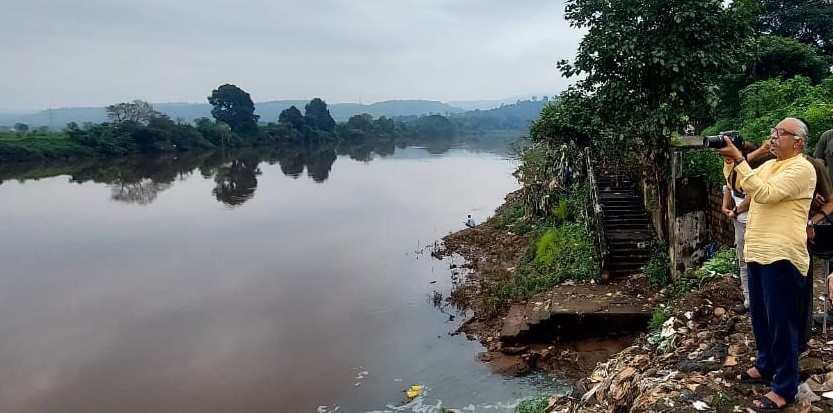
Image: Utkarsha Manish Chavan
From 2014 to 2021, they monitored the muggers of the river from six in the morning to twelve noon, from one in the afternoon to six in the evening and from seven to eleven at night. Sometimes they sat on the banks of the river and, sometimes, they sat in a boat to observe the muggers. In the approximately three-and-a-half-kilometre stretch of the Savitri near Mahad, the researchers documented about fifty mugger crocodiles[1].
The mugger population has been growing in recent decades, note the researchers.
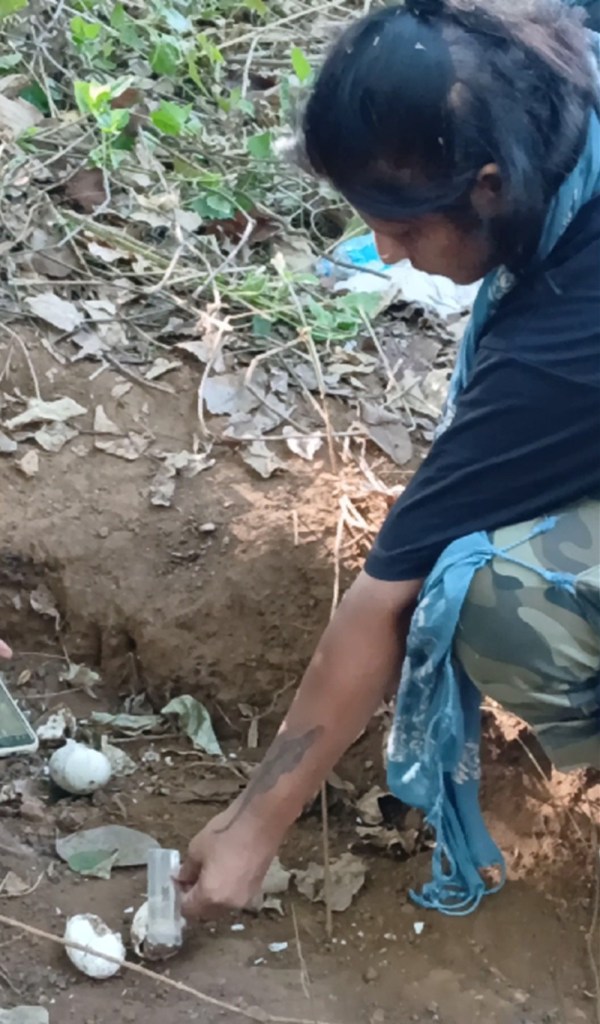
Utkarsha examining mugger crocodile egg shells Image: Manoj Borkar
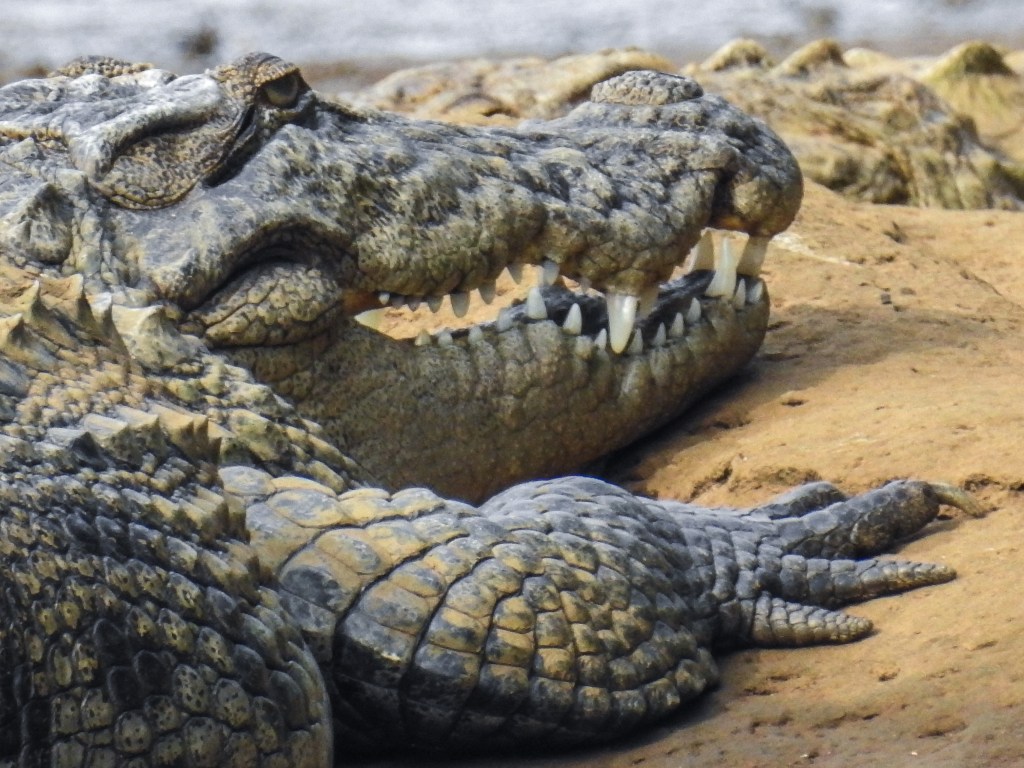
To study the crocodile population of the Savitri, the researchers used behavioural ecology and observational methodologies. Using binoculars and cameras, they have been documenting the behaviour of the muggers – their foraging strategies, habitat interactions, and inter-species interactions. Non-intrusive observations do not stress the animals. So the researchers could record the natural behaviour of the mugger crocodile. Their observations challenge the popular view that crocodiles mostly lie around like logs and only move according to basic survival instincts.
The muggers shuttle between land and water based on ambient temperature. Since the reptiles are cold blooded and have no internal mechanism to regulate body temperature, immersion in water, or basking or retreating into tunnels helps meet their temperature preferences. The muggers dig tunnels on the banks of the Savitri into which they sometimes go to rest or nest.
When a crocodile leaves the water to bask on dry ground, it goes through pre-basking, surface basking and shallow water basking behaviours. The time spent for each of these activities and at the various locations varies according to the season.
What do these muggers eat?
“We did not study the stomach contents of the crocodiles. That would have been invasive and would have required a permit from the forest authorities since the mugger is a Schedule I species as per the Indian Wildlife Protection Act,” says Manoj Borkar, Carmel College of Arts, Science and Commerce for Women, Goa.
The muggers seemed to sustain themselves mainly on fish [2]. The researchers observed that the muggers mostly hunted in groups of three. Such collaborative hunting is rarely seen among reptiles.
The muggers also prey on birds. Although there were some twenty-six species of birds from eleven families in the area, the muggers mainly caught egrets and herons. The birds are alert and often fly off before the muggers get to them.
“But we have seen muggers ambushing cattle egrets sitting on the lower branches of trees”, says Utkarsha, Bhavan’s Hazarimal Somani College, Mumbai.
The researchers measured bird flight initiation distance, quantifying the exact spatial threshold at which a bird flees from approaching predators. They observed and recorded the distances at which birds foraging and nesting along the riverbanks reacted to the crocodiles or their movements.
By mapping the flight initiation distance values for different bird species sharing the aquatic habitat, the researchers could estimate how birds assess the predatory threat level posed by muggers, reflecting fine-tuned ecological adaptation and behavioural synchronisation between predators and prey in a shared environment.
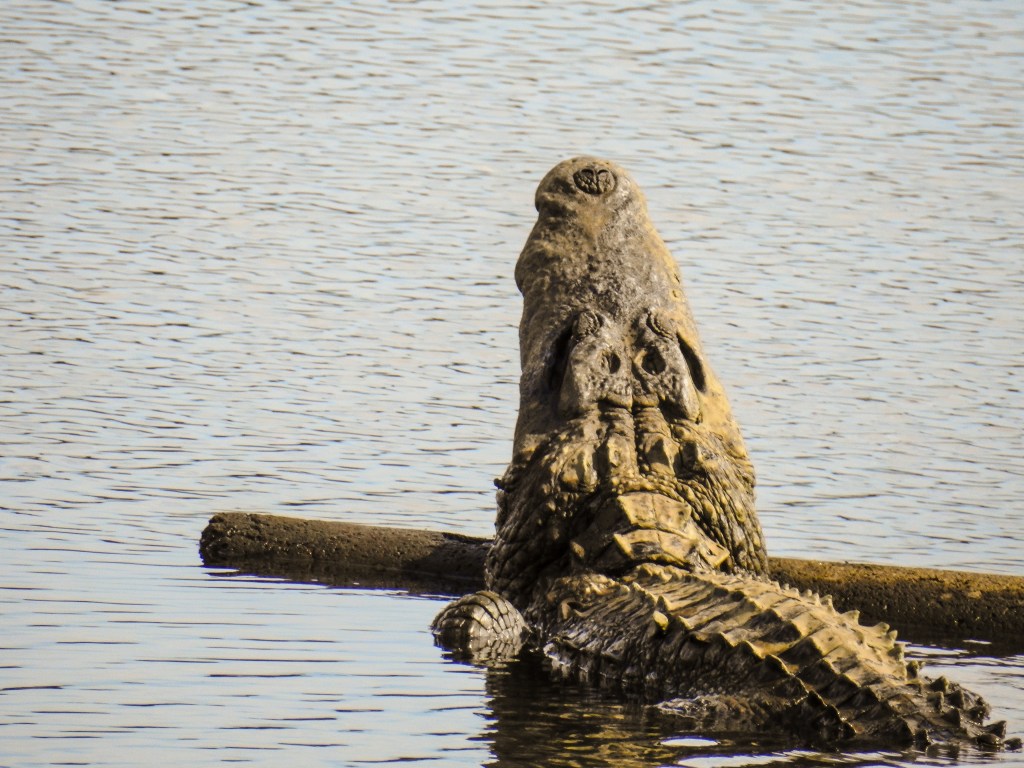
“We have observed muggers that were at first calmly resting under the trees, ambushing cattle egrets sitting on the lower branches of the trees,” says Manoj Borkar, Carmel College of Arts, Science and Commerce for Women, Goa.
The researchers also observed crocodiles using twigs as bait, a sophisticated predatory strategy akin to tool use or luring. At the height of the bird breeding and nesting season, the muggers remained motionless near floating twigs. Wading birds search for and collect twigs and vegetation for nest construction. A stationary, well-camouflaged crocodile adorned with or resting near twigs can trick unsuspecting birds into closing the distance gap until they fall within striking range.
The researchers documented instances where the muggers even positioned small sticks or branches across their snouts. Could they be exploiting the behavioural urgency of the birds desperate for nesting materials?
Besides birds, the muggers also scavenge carrion and chicken offal thrown into the river. Into the river, villagers often also throw marigold flowers from cremation and other religious rituals. The researchers noted that the muggers were attracted to the marigold flowers, basking, floating, or resting near the flowers.
“This could either mean that the muggers can see colours or, that they linger near discarded marigold flowers to reduce bacterial loads on their skin. Marigold flowers have antimicrobial and bacteriostatic properties”, says Utkarsha, Bhavan’s Hazarimal Somani College, Mumbai.
People living near the Savitri use the river for fishing, washing clothes and utensils, and for swimming. Though no casualties have been reported so far, there have been a few incidents of aggression by muggers. The work of these researchers offers practical mitigation measures. The research can be also be important for the conservation and management of these threatened species.
[1] Journal of Threatened Taxa 14 (11):22118-22132 (2022);
DOI: 10.11609/jott.7934.14.11.22118-22132
[2] Journal of Threatened Taxa 15 (8): 23750–23762 (2026);
DOI: 10.11609/jott.8551.15.8.23750-23762
Reported by Gita Madhu
Freelance science writer, Goa
The news reports on this site are free-to-use for Indian media houses.


Leave a comment