Button mushrooms are commonly found in vegetable shops in India. Oyster mushrooms have better flavour and high nutritional content. A recent survey shows that people are now developing a taste for it.
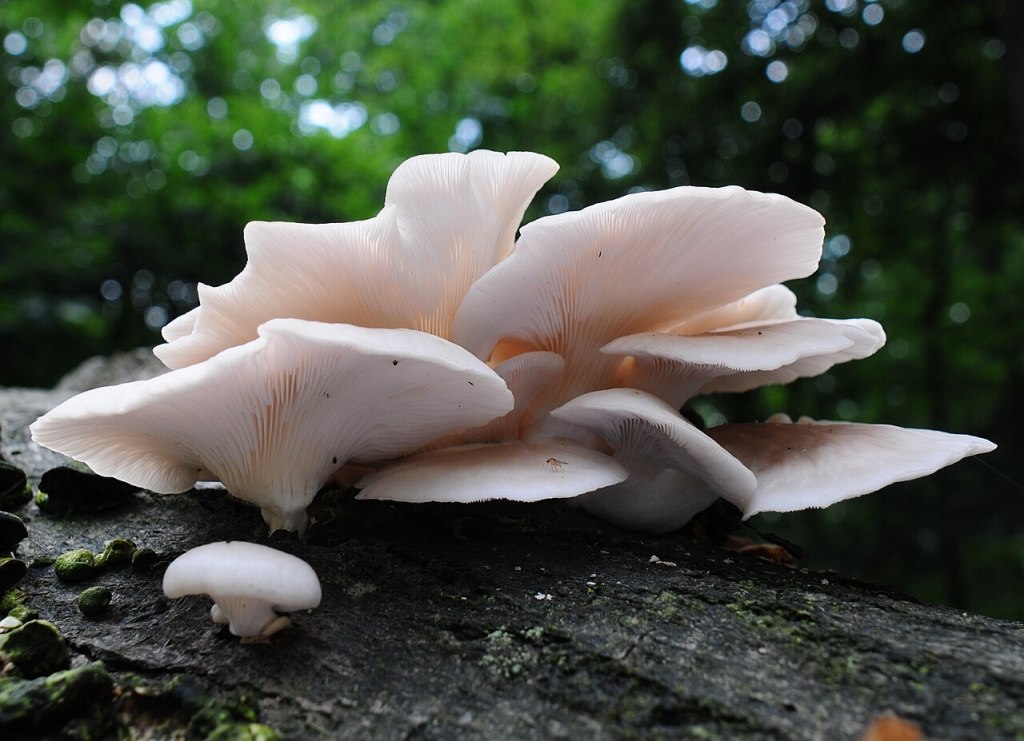
Image: Henk Monster via Wikimedia Commons
To meet the growing market demand, the IIHRPF-1 strain of oyster mushrooms was developed by the Indian Institute of Horticultural Research, Bengaluru. To improve the production of the mushroom, researchers at REVA University, Bengaluru designed rice straw bag filling machines as well as a portable manually operated machine for spreading spawn, the ‘seeds’ for growing mushrooms.
Recently, the researchers at REVA University collaborated with researchers at the RVS Technical Campus, Coimbatore and the Banaras Hindu University to tackle three problems:
Which is the best substrate for growing oyster mushrooms – rice straw, rice straw powder or saw dust?
What is the best spawn rate per kilogram of substrate for optimum production?
Does the production, productivity and profit make buying the straw bag filling machine and spawn spreading machine economically viable for mushroom farmers?
The researchers took rice straw cut into small pieces, rice straw powder and sawdust as substrates. The substrates were soaked in water, and sun-dried to the extent that they do not drip – about 65 percent more than the weight of the substrate.
One kilogram each of the damp substrates was loosely packed in polypropylene bags. The bags were plugged using cotton at the mouth of each bag with a ring around it and autoclaved to kill any bacterial or fungal contamination.
After cooling, the ring and plug were removed and the mushroom spawn was spread on the surface of the substrates at rates of 40, 50 and 60 milligrams per kilogram dry weight of the substrates. The bags were closed again using the cotton plug and ring so that fresh oxygen can enter and carbon dioxide can escape but dust and mold spores cannot get in and create damage to the crop.
When kept between 18 to 28 degrees centigrade for about a month, fungal mycelium spreads all over the substrate. Then small holes were made on the bags for the mushroom pinheads to emerge.
To support pinhead initiation and fruiting body development, the researchers kept the bags in controlled environmental conditions: the relative humidity was maintained at fifty-seven to seventy percent, by keeping the floor wet at all times. Diffused light for eight to ten hours is desirable.
It took about a month for the pinheads to appear. Within another month, the pinheads develop into mature fruiting bodies – the oyster mushrooms are ready to be harvested. It does not end after harvesting the first flush. More mushrooms can be harvested from the same bag, repeatedly.
Pinheads started appearing first in the bags with rice straw as substrate. But fruiting body formation was slower than with the other substrates. However, the bag containing 50 grams of spawn per kilogram of rice straw had the highest yield – nearly 200 grams per kilogram of the substrate.
Though the duration between flushes was lower in bags containing sawdust, the total yield was less than half of what was achieved with rice straw. Rice straw powder with 40 grams of spawn per kilogram had a slightly higher yield of about 100 grams per kilogram of dry substrate.
The researchers calculated the cost of production. The economics make this process attractive for small rice farmers. Dry rice straw costs zero rupees. Fifty grams of mushroom spawn costs about five rupees. The plastic bag and fuel for boiling add another five rupees, bringing the total cost per bag to just ten rupees.
Each bag produces around two hundred grams of fresh mushrooms, which can be sold at a local market price of forty to fifty rupees. This yields a net profit of thirty to forty rupees per bag, allowing farmers to turn cheap crop waste into a reliable extra source of income.
For the agriculturally lean season for paddy cultivation, especially in the coastal areas of India where humidity is high most of the year round, this could benefit rice farmers.
Those who want to upscale production could invest in the mechanical spawn spreading machine. Compared to manual methods, it is more hygienic, reduces contamination risk and ensures more uniform spawn distribution. It can spread the spawn in approximately 20–25 bags per hour and reduce labour.
The manually operated spawn-spreading machine comprises a conical hopper, dual ball-valve metering system and supporting frame. The cost of fabrication works out to be between 20 to 30 thousand rupees. It is available from agricultural machinery suppliers.
Plant Science Today 13 (2): 1-8 (2026)
DOI: 10.14719/pst.12239
Reported by Gita Madhu
Freelance writer, Goa


Leave a Reply