People usually judge milk by how it looks or by its smell. However, microbes in milk continuously change the milk’s composition long before it starts smelling bad or curdling.
Is there a simple way to reliably recognise that the milk has gone bad?
Researchers at the Kamdhenu University, Gujarat, recently came up with a simple idea. Red cabbage has anthocyanins, pigments whose colour changes across different pH levels. Why not use the pigments in red cabbage for calorimetric testing of milk?
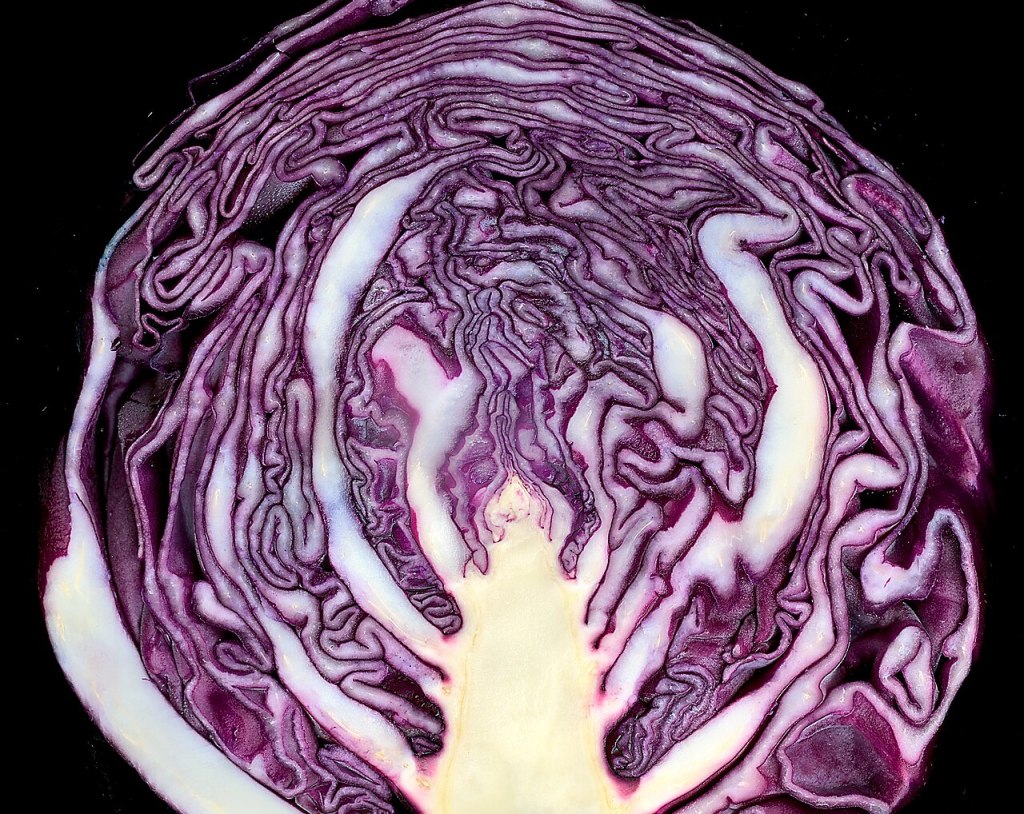
To create a sensor, the researchers extracted water-soluble anthocyanins from red cabbage and immersed small pieces of chromatography paper in the extract. Chromatography paper is a porous, lightweight and disposable solid support that can hold the plant dye evenly while allowing easy physical handling. The paper strips absorbed the anthocyanin solution uniformly.
Image: Amada44, via Wikimedia Commons
To test whether the plant molecules were bound to the paper matrix and will not be washed away when immersed in milk, the researchers used infrared spectroscopy to examine the chemical bonds and functional groups formed between the dye and the paper fibres. The results confirmed that the anthocyanin molecules were anchored to the cellulose structure of the paper through stable intermolecular interactions.
To test whether the plant molecules were bound to the paper matrix and will not be washed away when immersed in milk, the researchers used infrared spectroscopy to examine the chemical bonds and functional groups formed between the dye and the paper fibres. The results confirmed that the anthocyanin molecules were anchored to the cellulose structure of the paper through stable intermolecular interactions.
After ensuring that their sensor would remain intact when exposed to liquid dairy samples, the researchers used the sensor strips on milk samples undergoing progressive spoilage over time.
Bacterial proliferation in aging milk produces organic acids, causing a steady decrease in pH levels. The researchers determined the changes in pH along with an increase in total microbial count. Microbial growth in milk is exponential. At 30 degree centigrade, within a day, there were nearly eight million colony forming units of bacteria in milk. Measurements with a pH meter and titration suggested that the organic acids in milk exist in free and bound forms.
After establishing this baseline data, the researchers tested their paper strip sensor. As the acidity increased, the sensor strips underwent distinct, observable colour changes. The original reddish colour of the paper strip turned to purple, blue and green shades. These colour changes are due to reversible structural changes of anthocyanins in response to changes in pH, say the researchers.
They tested their paper sensor again and again, in several batches and different experiments to check the reproducibility of the results.
Tests on sensitivity and specificity showed that the paper strip sensors are 100% sensitive and specific.
What is the shelf life of the sensor?
The researchers tested and found that at 30 degrees centigrade, the sensing ability reduces significantly with a day. But under refrigeration, the shelf life was prolonged.
Relative humidity, temperature fluctuations, light exposure and other factors which may influence anthocyanin stability during storage need to be investigated, say the researchers.
These findings offer an easily accessible and affordable alternative to replace subjective smell tests and complex laboratory equipment with an immediate visual signal.
The innovation holds immediate practical relevance for dairy processors, commercial milk distributors, quality control regulators, and even milk consumers. Dairy industry boards and commercial milk packaging companies now need to partner with these researchers to scale up the manufacturing of standardised indicator strips for use in commercial dairy packaging across the supply chain.
Scientific Reports, 16:30877 (2026);
DOI: 10.1038/s41598-026-61811-0
Reported by Gita Madhu
Freelance writer, Goa


Leave a Reply