Assam is home to the largest number of Asian elephants in northeastern India. Rapid human population growth, infrastructure development and forest fragmentation have narrowed traditional elephant corridors, forcing elephants and people to compete for the land and resources. As a result, human-elephant conflict has emerged as a conflict between wildlife conservation and rural livelihoods.
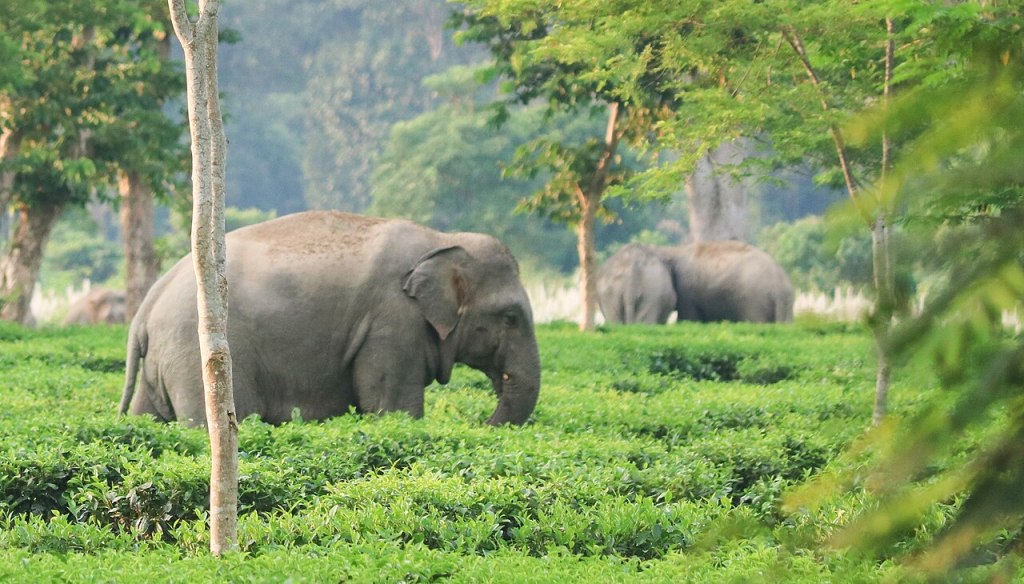
Image: Kumud Ghosh via Wikimedia Commons
What can we do to resolve, or at least to reduce, this conflict?
A team of researchers from the North-East Regional Centre of the Govind Ballabh Pant National Institute of Himalayan Environment, Itanagar, Arunachal Pradesh, and the Centre for Cellular & Molecular Biology, Hyderabad, began investigating human-elephant conflict in Assam.
Which are the high-risk zones where both species are most vulnerable?
The researchers reviewed records from 2010 to 2024. They collected information from media reports and through surveys with local communities. The researchers thus identified 2,384 conflict locations across 27 of Assam’s 35 districts. Nine were hotspots for elephant-human conflict: Tinsukia, Lakhimpur, Sonitpur, Udalguri and Baksa north of the Brahmaputra, and Golaghat, Nagaon, Goalpara, and Kamrup south of the Brahmaputra.
There were 1,468 human fatalities and 337 injuries during this time. During this time, about 1,200 elephants died. Half of these deaths were attributable to human beings. Electrocution was the leading human-driven cause of elephant deaths, followed by accidental deaths and train collisions. Retaliatory killings were also common.
Assam has only a little more than 4000 elephants. The number of elephant deaths was a significant blow for conservation efforts.
The data also showed that conflict has increased significantly since 2017. The conflict peaks in December. This is the season when elephants enter human areas in search of nutrient-rich crops such as rice and sugarcane.
What specific factors most strongly predict conflict?
The team identified 20 variables. To ensure the predictors being used were not redundant, the researchers used multicollinearity tests. A rigorous filtering process removed three predictors, leaving 17 variables to build the model.
Since elephants are known to travel long distances, the researchers evaluated each variable across six spatial scales: 1, 2, 3, 5, 10, and 15 kilometres. The researchers conducted this scale selection process separately for the elephant victimisation and human victimisation datasets.
They used an integrated framework for ensemble species distribution modelling, considering both humans and elephants. Various machine learning algorithms were combined to create a model that predicts where conflict is most likely to happen.
Before creating their risk maps, the researchers ensured the data were accurate by grouping events, correcting bias, and establishing comparison points. To ensure the methods were accurate and could generalise to new data, the researchers used a 10-fold cross-validation design. Before the final validation, the researchers implemented strategies to improve model quality, such as spatial thinning to reduce sampling bias. Thus, the researchers created bivariate risk maps that allow managers to see exactly where the hotspots are, so that they can focus on solutions such as early warning systems and corridor restoration.
To reduce conflicts, to encourage coexistence and to conserve the elephant populations, we must look at both sides – how human activities harm elephants and how elephants affect humans.
Policy actions must be timed seasonally to coincide with periods of maximum risk and focus on conflict hotspots in Assam.
To reduce conflict, communities near high-risk zones should grow alternative cash crops that elephants do not like to eat, such as medicinal or aromatic plants, say the researchers.
Scientific Reports, 16: 19693 (2026);
DOI: 10.1038/s41598-026-48970-w
Reported by Sanghamitra Deobhanj
Freelance science writer, Cuttack
The reports on this site are free to use for Indian media houses
STEAMindiaReports: science news you can use


Leave a Reply