The dried, yellowish leaves of sugarcane plants are not productive and do not contribute to photosynthesis. So they are removed five to seven months after planting. This process, known as detrashing, when done manually, takes nearly a month per hectare. And the sharp sugarcane leaves injure the hands.
Mechanised detrashers make the process more efficient and less painful. But existing mechanical detrashers have four fixed rollers that cannot be adjusted to the height at which the removal is done. So, the cane buds of different varieties, at different stages of growth, are often damaged in the process. As a consequence, farmers hesitate to buy the machinery.
Researchers from the Agricultural Engineering College and Research Institutes of the Tamil Nadu Agricultural University, at Coimbatore and Tiruchirapalli, recently overcame the problem by developing an adjustable attachment for mini tractors.

“We designed the detrasher for sugarcane planted at a five-foot row spacing. This is the spacing commonly adopted by farmers using mechanized harvesting”, says A P Mohan Kumar, Tamil Nadu Agricultural University.
The system has a mild steel frame, a power transmission system to connect to the mini tractor, a hydraulic circuit to power the moving parts and two rotating rollers with nylon ropes to do the detrashing.
“The design of the system focuses on adaptability”, says Kavitha Ramasamy, Tamil Nadu Agricultural University, Coimbatore campus.


“The hydraulic system allows height adjustment and adapts easily to different crop varieties”, explains R Thiyagarajan, Tamil Nadu Agricultural University, Tiruchirappalli campus.
“The rollers can rotate in both directions to prevent leaf entanglement”, adds A Surendrakumar, his colleague working at the Coimbatore campus.

The researchers tested their machine using a factorial randomized design and optimised the system by changing the parameters: roller speed from 8 to 12 metres per second, forward speed from 70 to 140 centimetres per second, and detrashing height from 300 to 600 millimetres.
Power consumption varied with operating parameters. The highest speed consumed double the power compared to the lowest. A roller speed of 8 metres per second with a 70 centimetres per second forward speed and a detrashing height of 600 millimetres proved to be the most efficient for detrashing. These settings also minimised damage to the sugarcane stalks.
The researchers conducted field tests with the system. The machine could handle a hectare of sugarcane within about half a day. Time for detrashing decreased by 70 per cent and labour requirements by nearly 90 per cent. Since sugarcane farmers find it hard to get people for the task, the detrasher could be a boon.
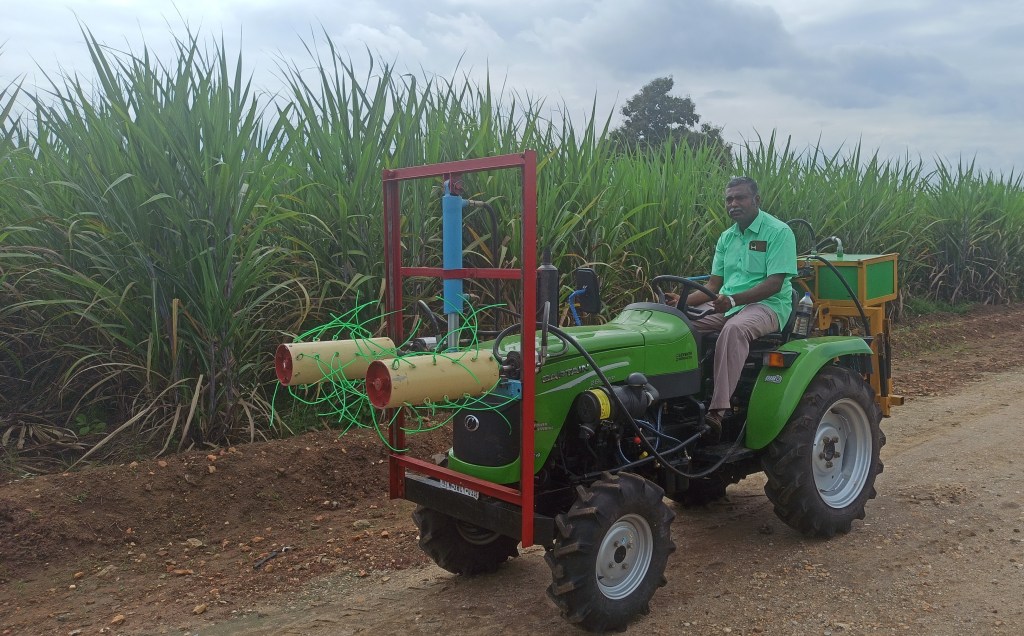
All photographs on this page courtesy TNAU
The costs for detrashing reduce by more than half. So this mechanised de-trasher is also economically viable for sugarcane farmers.
The researchers plan to automate the detrasher by adding sensors to further enhance its efficiency. Meanwhile, manufacturers of agricultural machinery can come forward to take the new design to the market.
Sugar Tech 2025;
DOI: 10.1007/s12355-025-01559-5:
Reported by Ravindra Jadav
Associate Professor, Government Science College, Santrampur
STEAMindiaReports: free-to-use science news for Indian media
scienceandmediaworkshops: training scientists, researchers and science faculty to write well targeting peers, decision makers, fund managers, students and educated public
 STEAMindiaReports
Leave a comment