The demand for dietary proteins has led to an increase in the production and storage of pulses in India. But pulses are vulnerable to pests, especially tiny beetles, bruchids, which bore into the pulses and eat them from inside.
The prevalence data on this pest in India is from the 1970s. To manage the pests of stored pulses, and to reduce losses, we need more recent data on the bruchid species and the level of infestation by the species in India.
To investigate, Revanasidda Aidbhavi and team from the ICAR-Indian Institute of Pulses Research, Kanpur collaborated with the University of Agricultural Sciences, and the Gandhi Krishi Vigyana Kendra, Bengaluru, to conduct a survey across 24 Indian states. They collected about 81 stored samples of 14 different pulses from 74 locations.
At the storage locations, they also set up artificial seed traps to collect infestations which had not developed during their visit to collect the samples. The researchers identified the bruchids they collected using morphological characteristics and molecular techniques.
They identified five species of bruchids infesting the stored edible legumes: Callosobruchus chinensis, Callosobruchus maculatus. Callosobruchus analis, Acanthoscelides obtectus and Caryedon serratus. Among these, Callosobruchus analis was found to infesting half of the samples collected while Callosobruchus maculatus was abundant and a dominant species. In large storage units, Callosobruchus analis was the most common, while in small-scale units, Callosobruchus maculatus was most common.
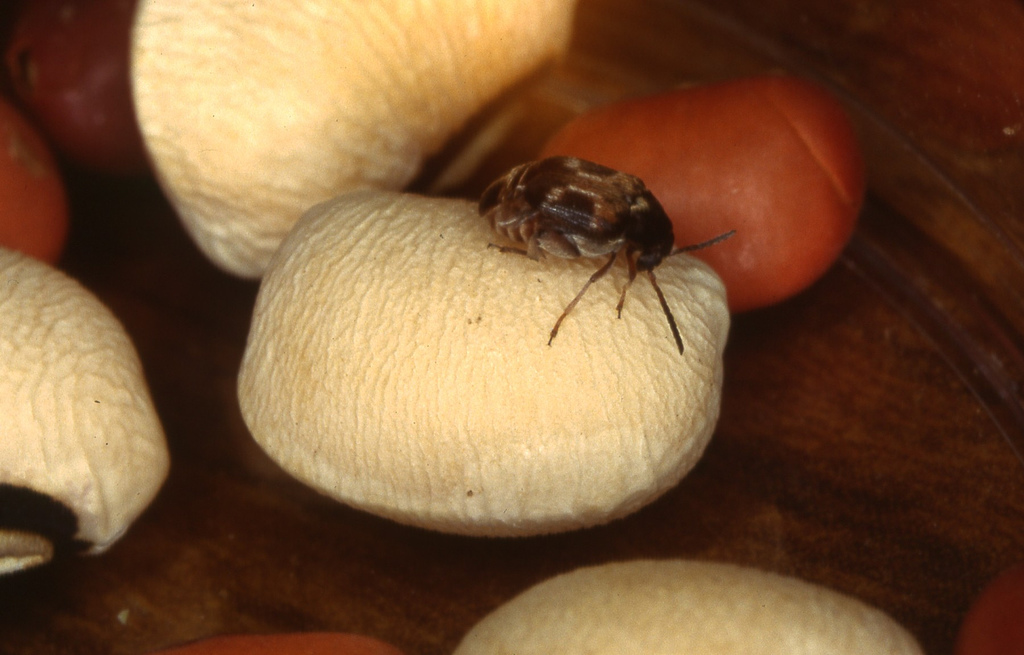
A Callosobruchus maculatus female. Image: Limbatus, via Wikimedia Commons
Madhya Pradesh, Andhra Pradesh, and Uttar Pradesh had high diversity of bruchids. Tamil Nadu and West Bengal recorded the lowest diversity.
Mung bean, horse gram, chickpea, cowpea and field pea were most preferred by the bruchids. Urad bean, or black gram, seemed to be the least preferred. Mung bean and moth bean had more infestations by C. maculatus, while in horse gram, pigeon pea, and field pea C. chinensis was more abundant.
The insect infestation increased with increase in grain moisture and storage time.
The researchers estimate that, on an average, nearly a quarter of the weight of stored pulses is consumed by bruchids in both small scale and large storage units. The loss can go up to half in small units and about three-fourths in large ones.
“Post-harvest processing, storage conditions and scientific management of bruchids need to be taken up to ensure that the protein rich pulses are not destroyed by pests,” says Revanasidda Aidbhavi, ICAR-Indian Institute of Pulses Research, Kanpur.
Journal of Stored Products Research 101: 102085 (2023);
DOI: 10.1016/j.jspr.2023.102085
Reported by Aparna Kalawate
Zoological Survey of India, Western Regional Centre, Pune
 STEAMindiaReports
Leave a comment