Several recent studies indicate a correlation between diabetes and circulating levels of adiponectin, a signalling molecule from adipose tissues that regulates cellular energy homeostasis in many other tissues, including the brain.
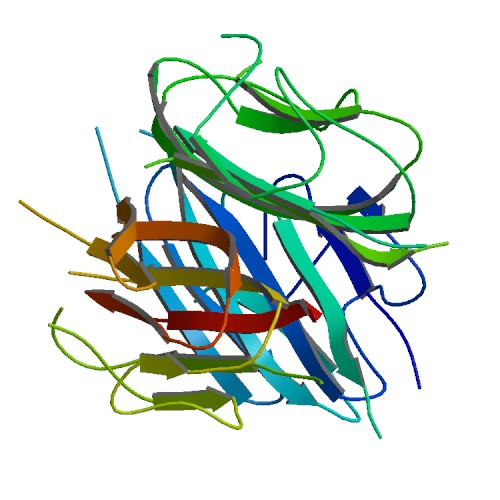
Adiponectin protein monomer. Image: Magnus Manske via Wikimedia Commons
Aged mice whose adiponectin gene was knocked out seem to develop Alzheimer-like pathologies. Moreover, the risk of developing Alzheimer’s disease increases by up to 90% in diabetic patients due to insulin resistance and impaired insulin signalling in the brain.
Treatment with AdipoRon, an agonist of adiponectin receptors, improves insulin sensitivity. Since symptoms of diabetes and Alzheimer’s disease overlap, can AdipoRon be used to ameliorate Alzheimer’s-associated pathologies?

AdipoRon molecular structure
Sarika Gupta and her team at the National Institute of Immunology, New Delhi started experiments on double transgenic APP/PS1 mice that express proteins associated with early-onset Alzheimer’s disease.
First, they tested the mice for glucose and insulin tolerance. The mice showed perturbed glucose clearance and reduced insulin sensitivity. AdipoRon administration improved these symptoms, as expected.
To investigate the underlying mechanism of improved glucose metabolism on AdipoRon administration, the researchers used western blot analysis of various intermediate molecules of insulin and AMPK signalling pathways involved in glucose uptake.
AdipoRon seemed to activate the AMP-activated protein kinase pathway. Using real time PCR analysis, the team found increased expression of glucose transporters 1 and 4 in the brains of the mice.
These findings were also confirmed by in vitro studies. AdipoRon treatment activated AMPK pathway, which, in turn, potentiated insulin signalling pathway and increased glucose uptake in insulin-resistant neuronal cells.
Normally, APP/PS1 mice show a severe decline in cognitive functions which is associated with Amyloid β42 plaque formation in the brain. Can AdipoRon reduce the amyloid burden in the mouse brain?
The researchers checked.
Using immunohistochemical methods and ELISA, they measured the levels of Amyloid β42 in the brains of the mice. AdipoRon administration, they found, reduced the levels of Amyloid β42.
How does AdipoRon reduce the amyloid burden?
The researchers investigated the pathways involved in Amyloid β degradation and its clearance from the brain.
Apolipoprotein E, low-density lipoproteins and neprilysin play an important role in amyloid degradation and its clearance by regulating the efflux of toxic Amyloid β from the brain into the bloodstream. The researchers performed western blot analysis for these proteins. There was an increase in the levels of these proteins.
One of the hallmark features of the disease is increased inflammation in the brain, correlated with the activation of astrocytes and microglia by the amyloid protein. So using immunohistochemistry techniques, the researchers measured the levels of glial fibrillary acidic protein, a marker for astrocytes and ionised calcium-binding adaptor molecule-1, a microglial marker. Upon AdipoRon administration, there was reduced expression of these markers.
The reduced amyloid burden led to reduced neuroinflammation which in turn led to improved behavioural performance and memory response in the mice.
These findings highlight the relevance of targeting brain insulin resistance to ameliorate the pathology and symptoms of Alzheimer’s disease.
Repurposing AdipoRon to reduce pathologies associated with Alzheimer’s may perhaps be a simple solution. However, clinical trials are needed to validate its safety and efficacy in humans.
Neurobiol Dis. 174:105876 (2022);
DOI: 10.1016/j.nbd.2022.105876
Reported by Neha Jawla
Molecular Genetics Lab
National Institute of Immunology, New Delhi
*This report was written in a workshop on science writing organised by NII
 STEAMindiaReports
Leave a comment