In some patients with type 2 diabetes, the kidney starts malfunctioning causing proteins to be secreted in urine. When urine contains more than 29 micrograms of the protein, albumin, per gram of creatinine, the person is diagnosed as having diabetic nephropathy.
But, by this time, the kidney is already damaged. Can we recognise the problem before the kidney is damaged?
Researchers at the Medical College Hospital, Thiruvananthapuram started investigating.
The glomerulus of the kidney has highly specialised cells, podocytes, which form finger-like protrusions that wrap around blood capillaries that supply glomerulus. These protrusions have slimy sheaths which create a filtration barrier. Water and dissolved solids are allowed to go out as urine, but proteins are retained. This mucous-like substance is made of a protein, podocalyxin.
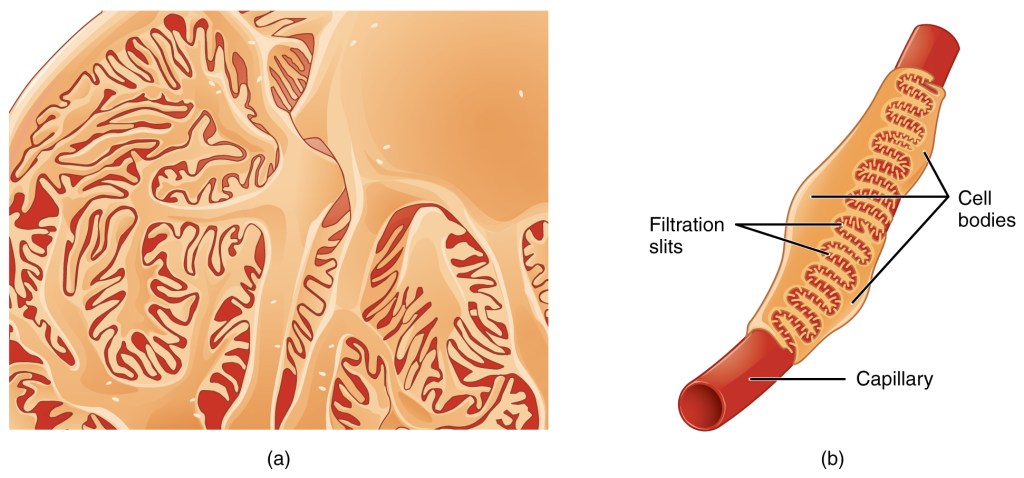
(a) part of glomerulus, (b) Podocytes and capillary. Image: OpenStax College via Wikimedia Commons
If the podocytes lose their podocalyxin, they become flat and leaky. In patients with diabetic nephropathy, this protein is also seen in urine.
Can podocalyxin in urine be an early indicator of the development of nephropathy?
The researchers decided to check.
They enrolled thirty type 2 diabetic patients with albuminuria and another thirty patients with type 2 diabetes, but without albuminuria as well as thirty healthy, age and gender-matched controls.
The researchers excluded patients suffering from kidney disease other than diabetic nephropathy. They also excluded patients with uncontrolled hypertension, congestive heart failure, and urinary tract infection, as well as menstruating and pregnant females.
They collected ten millilitres of midstream urine samples from all volunteers and centrifuged them to separate proteins in the samples. The samples were stored at minus twenty degree centigrade.
Using an enzyme linked immunosorbent assay, they estimated urinary podocalyxin and urine albumin levels. Urine creatinine levels were also measured using standard methods.
There were significantly higher levels of podocalyxin among the microalbuminuric group than in the normoalbuminuric and healthy control groups. The researchers observed elevated levels of urinary podocalyxin in diabetic patients even before the appearance of macroalbuminuria.
The elevated levels of urinary podocalyxin among the normoalbuminuric group indicates that podocyte injury in diabetic patients may not be detected even before albuminuria becomes significant.
Early detection of diabetic nephropathy by estimating urinary podocalyxin levels in routine screening will be helpful in preventing kidney disease progression. Early detection will also help clinicians implement timely therapeutic and personalised kidney care strategies. But to confirm that urinary podocalyxin is indeed an early biomarker for diabetic nephropathy, we need multicentre studies that correlate urinary findings with renal biopsies, say the researchers.
Indian Journal of Medical Biochemistry 30 (2):135–140 (2026);
DOI: 10.5005/jp-journals-10054-0275
Reported by Umme Najiya Mahwish
Freelance science writer, Hyderabad
This report was written during a workshop
organised by scienceandmediaworkshops
for training researchers
to write reviews, scientific papers and project proposals.
The reports on this site are free-to-use
for Indian media houses.
 STEAMindiaReports
Leave a comment