The nutrition pregnant women receive is important for the wellbeing of the baby. But to what extent?
To explore the problem, in 1993, Dr Chittaranjan Yajnik, KEM hospital, Pune initiated a study to measure micronutrients in pregnant women and found that two out of three pregnant women had low vitamin B12 levels. The results also suggested that the lack of adequate B12 during pregnancy may lead to obesity and insulin resistance in their children.
This led to a multi-institutional project. Between 2012 and 2020, a double blind study was conducted where young adolescents born to women were the subjects. Some adolescents were given B12 with other micronutrients, some received vitamin B12, and some, a placebo. The results suggested improvement in the ponderal index in babies born to females who had received the micronutrient supplements as adolescents. The ponderal index, calculated as body weight divided by height cubed, is a better measure of obesity than BMI, calculated as body weight divided by height squared. This confirmed the results of the earlier study.
The study also detected changes in the expression of genes involved in the cell cycle.
What are the molecular mechanisms that lead to changes in gene expression, obesity and the risk for diabetes?
To investigate. Satyajeet Khare, Symbiosis School of Biological Sciences, collaborated with researchers at KEM hospital, IISER Pune, Shiv Nadar University and a university in the UK.
Defects observed in children whose mothers did not have adequate vitamins and minerals were typical signs of some changes in gene expression. Gene expression could change because of chemical changes such as methylation in DNA or histones that package DNA or RNA. Vitamin B12, B9, B2, and B6 are potential donors of the methyl group. They may influence the epigenetic regulation of fetal growth and development, they reasoned.
The researchers started investigating the impact of the vitamins on methylation. They used a placebo-controlled, double blind trial on adolescents from rural Pune. The adolescents were 266 females born to women who had participated in the earlier maternal nutrition study; 166 were married, became pregnant, and 149 of them had babies. During pregnancy, these women were given vitamin and mineral supplements.
By now, the government also had a policy of providing vitamin B supplements to pregnant women. To reduce the problems that this could create in their results, the research team checked vitamin B levels in the young mothers, and took cord samples from the newborns. Interestingly, vitamin B12 levels in the cord samples were higher than the levels in the mother’s blood. The babies were being preferentially supplied vitamin B12 through the cord!
What are the associations between vitamin concentrations in the cord blood and expression of genes?
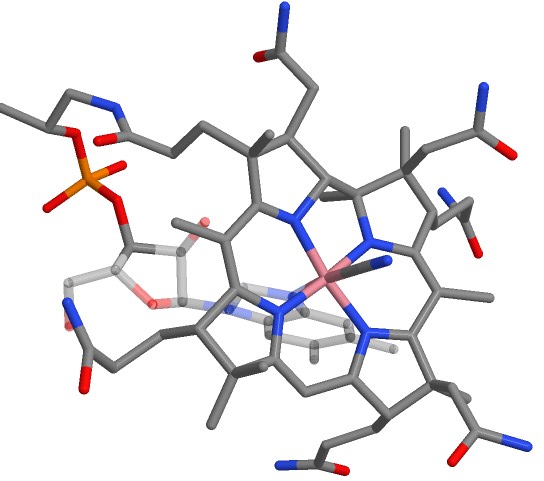
Representation of hydrated vitamin B12 molecule Image by Easyloc via Wikimedia Commons.
The researchers separated mononuclear cells from 88 cord samples and extracted the RNA. The RNA samples were sequenced. The sequencing data was high quality in only 79 samples. So the researchers limited further study to these samples.
They used weighted gene co-expression network analysis, which groups genes with similar functions. The analysis showed that 75 genes were differentially expressed in the mononuclear cells in the cord blood of the newborn. Based on the expression patterns of the genes in these cells, the researchers identified 23 distinct gene modules. The gene modules involved showed significant correlation with the clinical measurements.
The researchers separated mononuclear cells from 88 cord samples and extracted the RNA. The RNA samples were sequenced. The sequencing data was high quality in only 79 samples. So the researchers limited further study to these samples.
They used weighted gene co-expression network analysis, which groups genes with similar functions. The analysis showed that 75 genes were differentially expressed in the mononuclear cells in the cord blood of the newborn. Based on the expression patterns of the genes in these cells, the researchers identified 23 distinct gene modules. The gene modules involved showed significant correlation with the clinical measurements.
The researchers analyzed gene ontology to determine the molecular functions of these genes. The genes identified control growth, as well as the division and specialization of cells. Some of them have a significant role in embryonic development.
Some were genes coding for demethylases that can remove methyl groups and some were methyl transferases that can add methyl groups.
There was a negative correlation between vitamin B12 and the six enzymes involved in removing methyl groups from histones, the proteins that package DNA. The methylation of histones is a switch that opens up or closes a section of the DNA for transcription into RNA depending on where and which histones are methylated.
“Since there is a reduction in the expression of six demethylases, vitamin B12 supplements may exert extensive epigenetic control of gene expression,” says Sanjeev Galande, IISER Pune.
Among them, there were also six methyl transferase enzymes that added methyl groups to RNA, with positive correlation with B12 concentrations in cord blood. RNA methylation is known to alter the stability, as well as the transport and translation of the code to protein. The methylation of transfer RNAs suggested a role in amino acid synthesis.
“This suggests that vitamin B12 supplementation has an epitranscriptomic impact, leading to changes in the translation of RNA into proteins,” says Chittaranjan Sakerlal Yajnik, KEM Hospital, Pune.
“When B12 is insufficient, the system that regulates the transcription of DNA into RNA and the translation of the code into proteins may be disrupted,” adds Satyajeet Khare, Symbiosis School of Biological Sciences, Pune.
Vitamin B2 also showed a weak positive correlation with the expression of histone demethylases. But the levels of vitamin B6 and B9 had no correlation with changes in gene expression.
Nutritional status during pregnancy can have lifelong effects. A mother’s vitamin B6 and B12 levels affect not only fetal growth, through epitranscriptomic regulation, but also actively reprogram how a baby’s genes behave through epigenetic mechanisms. And epigenetics often shapes health for life.
Is that why nutrient deficiency during pregnancy leads to obesity and diabetes in the babies?
Keep in touch with the scientific research that is bound to follow.
Journal of Developmental Origins of Health and Disease 17: e4, 1–7 (2026);
DOI: 10.1017/S204017442510038X
Reported by Thamanna Sadique
Symbiosis Institute of Media and Communication, Lavale, Pune
This report was written as part of an assignment
given to media students in a workshop
at the Symbiosis Institute of Mass Communication, Pune.
We organise training workshops aimed scientists and science faculty,
to improve skills for writing scientific papers, reviews and grant applications.
Training workshops for PhD scholars to help accelerate
the writing of their thesis are also organised periodically.
For details of such workshops, click on the link below:
scienceandmediaworkshops.
 STEAMindiaReports
Leave a comment