Image: Yogita Karpate
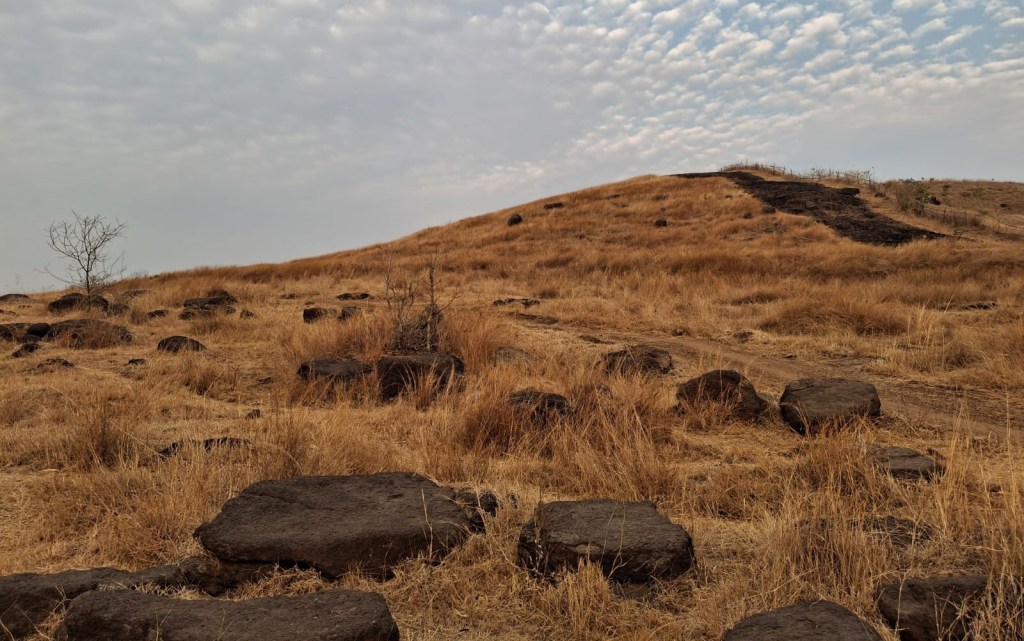
The Deccan, to the north of the Western Ghats in Maharashtra, hosts a rich mix of habitats, nestling within basaltic rocky outcrops: semi-evergreen forests, thorny scrub jungles, and savannas. What was this landscape like centuries ago? Were there grasslands, dense forests, or something in between?
Palaeobotanists reconstruct past natural history from fossilized pollen and spores. To peep into the past, paleoecology uses phytoliths, tiny silica crystals, that plants, when they perish, leave behind in soil sediments and rocks. Phytoliths survive for thousands and millions of years with clues about the flora of the region.
Is there a way to discover what a region was really like some hundred years back?
Recently, Ashish Nerlekar, Michigan State University, USA and Digvijay Patil IISER Pune decided to use a multi-pronged approach for the purpose.
They consulted scholars to find rare relevant literary works to trace references to the region’s ecological past in Marathi literature. From the first known text composed in the 13th century to texts from the 20th century, the duo scanned through a large corpus of folk songs, biographies, myths and narrative poems to identify descriptions of natural flora and fauna explicitly linked to locations in seven districts of western Maharashtra. They thus extracted 28 excerpts.
In the 28 excerpts, there were references to 68 species. For 63 plant names, the researchers could establish botanical identity: 28 plant species were exclusively wild and 16 were wild and cultivated. They then classified the habitat-level preference of each species and found 27 savanna indicator species, and 14 were generalists. Only three were forest indicators. So, the evidence from texts suggests mixed habitats or savannas, interspersed with tree species in this region.
The researchers examined mentions of the co-occurence of plants and animals in the texts. In the texts, which were in an old form of Marathi, when discussing araṇya or vana (often translated as forest), there were mentions of savanna grasses and stunted shrubs. Such grasses are not frequent in closed-canopy forests. So araṇya or vana as forest is an ecologically incorrect translation. Vana denotes wild or uninhabited locations not used for agriculture. Jāṅgala does not refer to a closed-canopy forest, but to drier landscapes such as grasslands, scrublands and savannas. Closed-canopy forests are referred to as anūpa.
Nerlekar and Patil attribute the confusion between savannas and forests to linguistic and colonial distortions. To collect revenue, the British labelled land as agricultural or as forests There was no administrative category for rocky grasslands. Thus, the British inadvertently created a false historical record of forests that perhaps never existed there in the first place.
The researchers could see the persistence of species described in the texts in present times in Pune, Nashik, Satara, Solapur, and Ahilyanagar districts, though these districts have surely seen changes brought about by the way the land has been used. This continuity provides strong evidence for the historical presence of mixed habitats in this landscape.
Descriptions in the texts about pastoral ways of life confirm the historical existence of grasslands in this area. The high productivity of these grasslands is evidenced by the mention of frequent migrations of animal herders. This implies that animal-based occupations have been there since long in this region. The animals and the herders must surely have contributed to seed dispersal, helping the natural evolution of mixed habitats in the region. Therefore, the 750 years of evidence from Marathi literature challenges the popular narrative that the existing grasslands are wastelands resulting from deforestation during the colonial period.
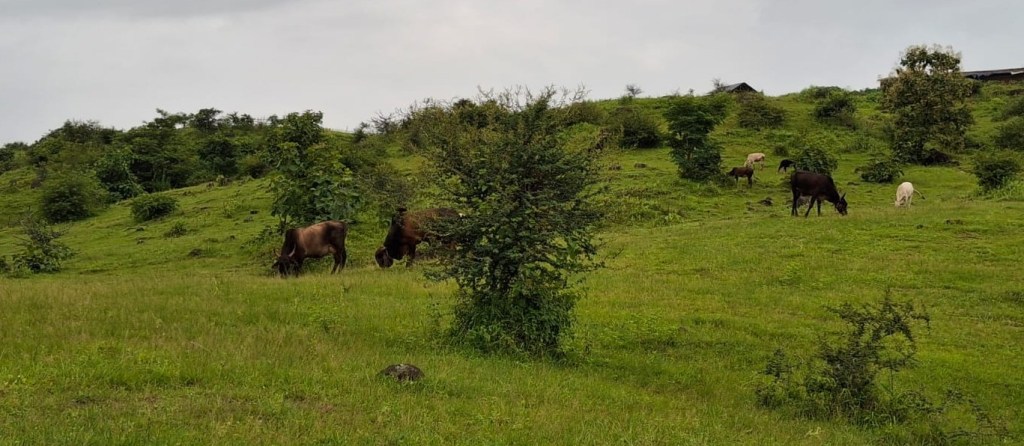
Image: Yogita Karpate
The texts also revealed strong cultural ties between the human communities and the tropical savannas in the Sahyadri. These linkages could have helped preserve the landscapes over the centuries.
By triangulating traditional literature with scientific (botanical, ecological, and climatological) data and an understanding of the traditional occupations of people in the region, one clear understanding that emerges: biodiversity conservation cannot be isolated from cultural traditions.
“There is enough evidence that biodiversity and cultural diversity are strongly interlinked. Where biodiversity is poor, cultural diversity also reduces”, says Ashish Nerlekar, now teaching at IISER Pune.
“Humans are an integral part of the natural ecosystem, and information on human interactions with their surroundings could serve to guide restoration practitioners and policy makers”, adds Digvijay Patil, IISER Pune.
The question now is how do we conserve these landscapes in the current era of rapid land-use change and climate degradation?
One step could be building reference models to serve as target ecosystems for on-ground decision-making for the restoration of degraded areas. The material for building such models can be sourced from ancient texts, or by consolidating historical evidence from paintings from past centuries, or paleoecological research, or a combination of all.
But the question which still remains unanswered is, how far should we go back in the past to make conservation and restoration decisions in current times?
DOI: 10.1002/pan3.70201;
People and Nature. 8:81–98 (2026)
Yogita Karpate
Research Associate, 14 Trees Foundation, Pune
This report was written in a workshop on science communication
organised by scienceandmediaworkshops
All reports in this site are free-to-use for Indian media houses
 STEAMindiaReports
Leave a comment