Water from the Pir Panjal Mountain range in the southwest and the Greater Himalaya range in the northeast flows into the Jhelum basin, which encompasses the Kashmir Valley. The basin has an area of more than 15000 square kilometres, of which about 70 square kilometres is covered by 140 glaciers.
The basin receives very little rainfall from the summer monsoon. Most precipitation occurs in the form of snow in winter brought by the western disturbance. The Jhelum river remains perennial due to snow and glacier melt.
If the climate changes, as predicted by existing models, what will happen to the glaciers in the Jhelum basin?
Over the last few decades, Shakil A. Romshoo, University of Kashmir, has been studying the glaciers in the basin. Recently, he collaborated with Tariq Abdullah, and Jasia Bashir from the Islamic University of Science and Technology, Kashmir to investigate changes in the mass balance of the glaciers and to project possible future changes in the basin’s glaciers.
In Landsat satellite images, the team manually delineated changes in the glacier area from 1980 to 2020. By means of field observations in the basin, they confirmed a decline in glacier area for several benchmark glaciers.
To forecast possible changes in the glaciers up to the end of the 21st century, the researchers used projections from 13 bias-corrected shared socioeconomic pathways, from the coupled model intercomparison project phase 6, CMIP6.
Shared socioeconomic pathways, SSPs, are scenarios of the future under different developmental trajectories of a society. The researchers applied the shared socioeconomic pathway 245, representing moderate fossil fuel use, and the shared socioeconomic pathway 585, indicating high fossil fuel dependence. By the end of the 21st century, compared to the baseline period from 1980 to 2017, the temperatures were projected to rise by 1.8°C under the shared socioeconomic pathway 245 and by 3.8 °C under the shared socioeconomic pathway 585. By 2080, precipitation is projected to increase by less than 2 percent under the shared socioeconomic pathway 245 and by 14 percent under the shared socioeconomic pathway 585.
Using a volume-area scaling approach, the team estimated future glacier area and mass balance changes in the basin. They estimate that, under the shared socioeconomic pathway 245’s scenario, glacier area could shrink by more than one-third and by more than half underthe shared socioeconomic pathway 585 by the end of the century.
A temperature-index melt model, validated with field measurements predicted an average annual loss of about four metres of water equivalent under SSP235 and about seven metres under SSP585 by the 2080s.
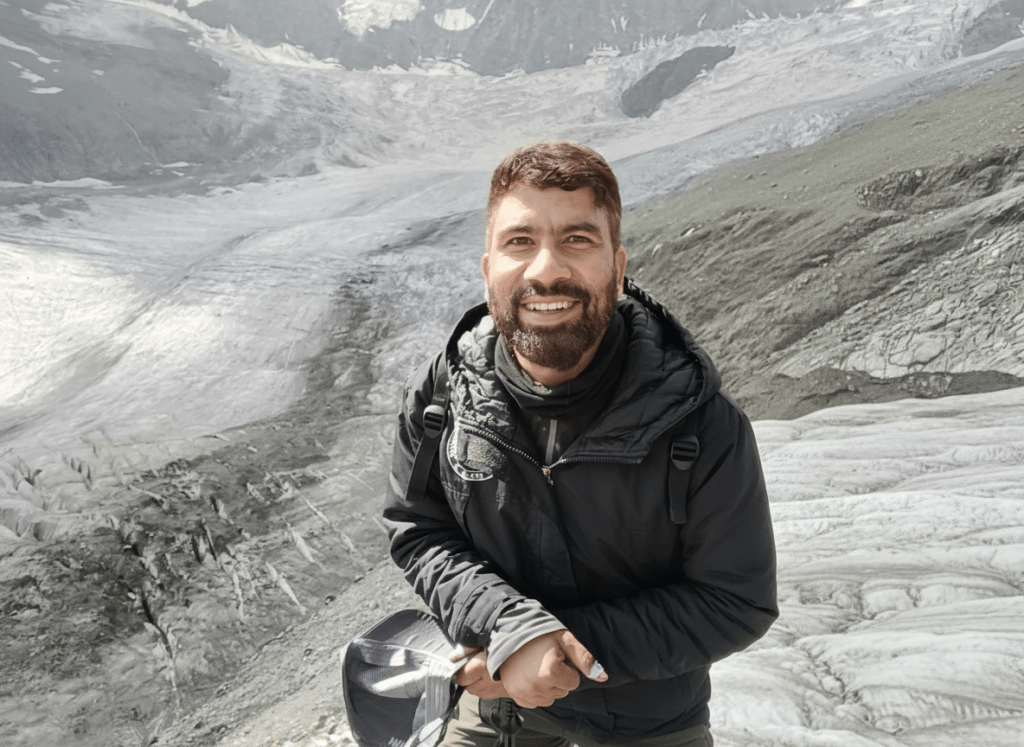
“The projections indicate that streamflow could eventually decline as melting reaches a critical tipping point. This could result in irrigation shortages during peak water demand”, says Tariq Abdullah, Islamic University of Science and Technology, Kashmir.
“These changes in the perennial water resources could threaten agriculture, hydropower and overall water security in the region”, warns Jasia Bashir, his colleague.

“There is an urgent need to integrate glacier change projections into long-term water resource planning and climate adaptation strategies in the Jhelum basin”, says Shakil Ahmad Romshoo, University of Kashmir.
Are the decision makers listening?
iScience 28: 113200 (2025);
DOI: 10.1016/j.isci.2025.113200
Reported by Sheikh Aneaus
University of Kashmir, Srinagar
STEAMindiaReports: science news that matters to India,
free to use for Indian media houses
scienceandmediaworkshops:
building the capacity of researchers scientists and science faculty in India
to mediate science to peers, funding agencies, policy makers,
and the educated citizens
 STEAMindiaReports
Leave a comment