Ram Kulkarni has been fascinated by the smell of ripe mangoes even as far back as a PhD scholar in NCL more than a decade ago. He continued to be fascinated, though his research took a different turn as a post doc at IISER Pune. Now he is a professor at the Symbiosis University, Pune. His interests have widened, but the fascination with the aroma of ripe mangoes remains.
The mouth-watering smell of a ripe mango is due to volatile substances. Some fraction of these volatiles is bound to glucose, limiting its volatility and making it odourless. However, hydrolysis of these glycosidic aroma precursors by β glucosidases can release the aroma substances.
When mango pulp and juice are processed in industries, the endogenous β glucosidases in the fruits are inactivated. So though the aroma precursors persist, the aroma is lost. If industries that produce mango pulp and juice had access to these enzymes, the aroma of these products could be improved naturally and sales would increase.
Ram Kulkarni and team started looking for chances to harvest β glucosidases. They came across a paper published in 2021 which reported a lactic acid bacterium, Lactiplantibacillus plantarum, which had quite a few glucosyl hydrolases. They sequenced the whole genome of a strain of this bacterium.
Ram Kulkarni set his research scholar, Ravish Godse, the task of diving deeper into mango aroma chemistry and encouraged Joyleen M. Fernandes, an M.Sc. intern, to help Ravish.

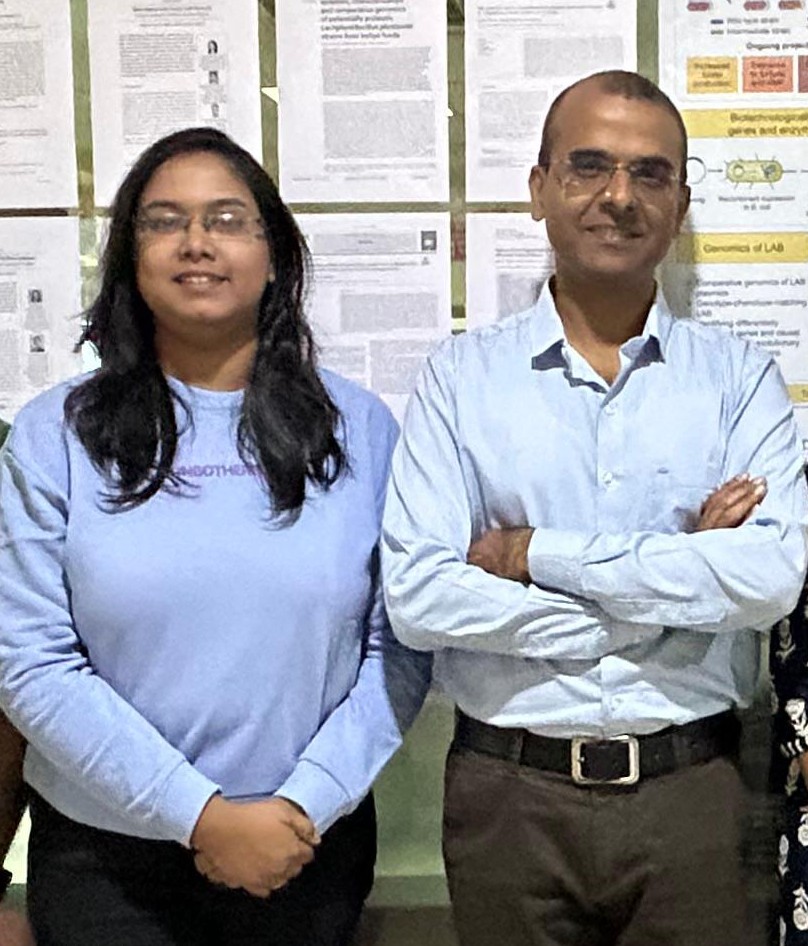
Ravish Godse, Joyleen M. Fernandes and Ram Kulkarni
Ravish and Joyleen took the genomic data of the bacillus and used an online tool to look for the open reading frames of 10 putative genes for the glucosyl hydrolases. They annotated the genes and, using another tool, predicted the molecular weights of these enzymes with the help of yet another online tool.
They amplified each of the genes separately, inserted each of them into plasmids and put them into E. coli, a model organism that is easy to cultivate. They expressed the genes and separately produced recombinant proteins of the ten enzymes.
Since they had a rough idea of the molecular weight of the enzymes, it was not too difficult to separate and purify each of these enzymes – though the process is actually laborious. One of the enzymes, for example, just refused to be produced and they had to struggle through the process.
Now the problem was to identify which of the ten enzymes was capable of hydrolysing aryl β glucosides – the sugars linked to aroma compounds. The researchers tested the enzymes on a synthetic chemical, glucose-linked nitrophenol. When glucose is separated from nitrophenol, the medium turns yellow, the colour of nitrophenol. Only one enzyme led to the liquid becoming yellow. So now they had identified the enzyme. It had higherβ–xylosidase activitythanβ-glucosidase activity.
Ravish determined the pH and temperature at which the enzyme activity was optimum. The enzyme was active from pH 4 to 8 with an optimum at a mildly acidic pH of 6. It was active from 20 to 70 °C with an optimum at a temperature of 40 °C.
The presence of metals had no impact on the activity of the enzyme. Monosaccharides, too, did not reduce the activity. In fact, glucose and xylose increased the activity of the enzyme, meaning that the end products of catalysis stimulated the enzyme. This was a unique trait — similar enzymes from other microbes are known to be inhibited by these monosaccharides.
The team decided to do the ultimate test. They got the famous Alphonso mangoes from the Sindhudurg district, Maharashtra and (besides slurping on them when no one was looking), extracted all glycosidically-bound volatiles from some of the mangoes. There were 19 volatile compounds.
They tested the enzyme on the juice extracted from the pulp. It released six volatile compounds belonging to monoterpenoids, phenolics, and norisoprenoids classes.
Ram Kulkarni and team at Symbiosis are happy with the results. They checked whether the enzyme works in the presence of ethanol. If it did, it could be used to enhance the aroma of wine. Grapes are cultivated in large quantities in Maharashtra and there are quite a few wineries who would be happy to buy the enzyme.
But, no, even 5% ethanol reduced the activity of the enzyme to 60%. The researchers say that, with a little biotechnological tinkering, the enzyme can be made active even in the presence of ethanol. They look forward to more work in this direction.
Ravish will get a PhD for this work, Joyleen got enough lab experience to join a university in Germany and Ram Kulkarni has exciting work going on in his lab in similar areas.
Applied Microbiology and Biotechnology 109:86 (2025)
DOI: 10.1007/s00253-025-13472-8
Reported by Atig and P K Udham
Freelance writers, Goa
STEAMindiaReports: delicious and aromatic science news from India
scienceandmediaworkshops: workshops on science writing for scientists, science faculty and researchers
Last date for applying to capacity building workshop for PhD scholars in India: 30 April 2025
More details in this link
 STEAMindiaReports
Leave a comment