
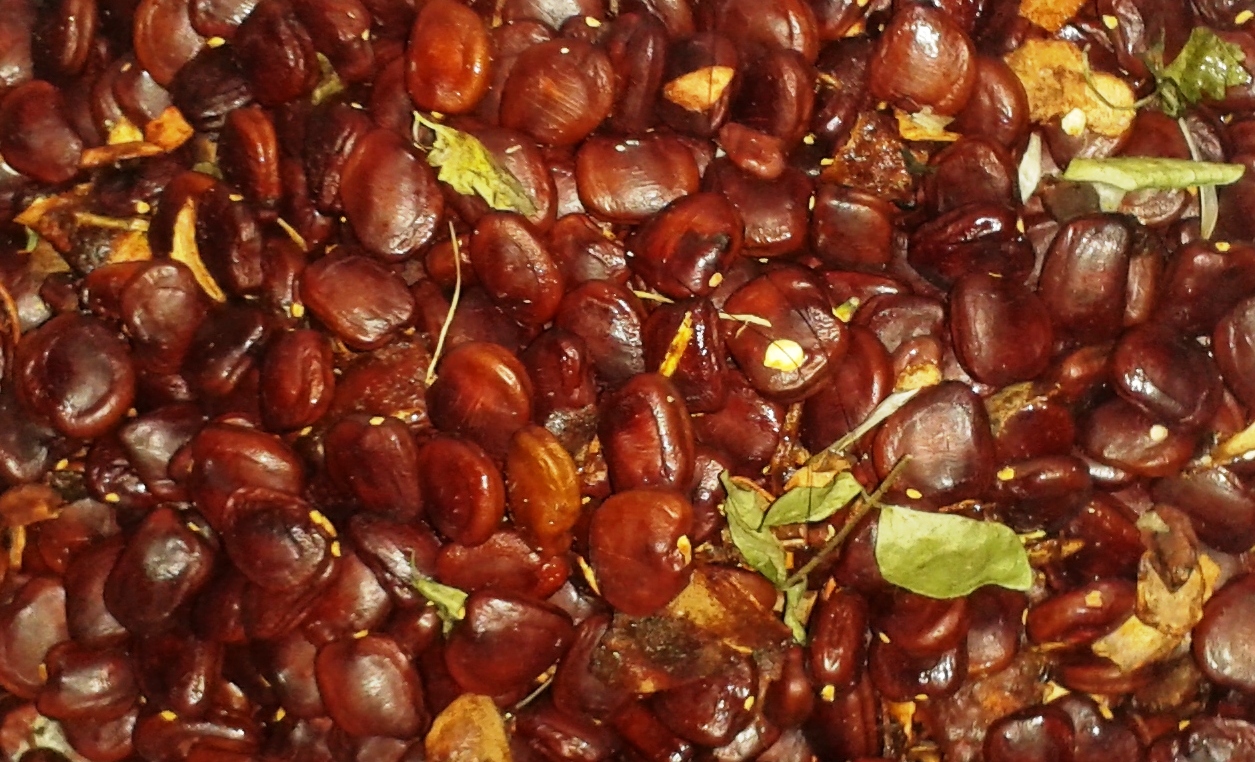
Image credits: Shagil Kannur and Aditya Madhav via Wikimedia Commons
Jackfruit seeds are wasted in large quantities every year in India. The seeds have high amounts of carbohydrates and could be used to make thin films to replace plastic.
Of course, unlike plastic, carbohydrate films are weakened by exposure to water. But this could be fixed by mixing the carbohydrates with other biopolymers and nanoparticles. And this is what R Santhosh and Preetam Sarkar from the National Institute of Technology Rourkela did. They made a film by mixing carbohydrates from jackfruit seeds with xyloglucan, a polymer from tamarind seeds, and zinc oxide nanoparticles.
They prepared jackfruit seed flour, removed fats from the flour by mixing it with sodium hydroxide solution, and centrifuging it. Fibre was removed by dissolving the carbohydrates in water and filtering the solution. The duo collected the carbohydrates, dried and ground and sieved them to get a fine powder which they mixed with zinc nanoparticles.
To extract xyloglucan from tamarind seeds, they boiled them to remove their brown kernel coat. They dried and ground the kernel to a fine powder. To remove unwanted components, they mixed the powder with distilled water and let it stand overnight. The following morning, they centrifuged it. The supernatant contained xyloglucan.
To separate xyloglucan from water, the researchers used a trick: they added absolute ethanol to the solution. Ethanol creates a hydrogen bond with xyloglucan, displacing a water molecule, leading to the formation of a gel within 30 minutes. The researchers filtered the gel using a muslin cloth, and dried, ground and sieved the xyloglucan flakes.
They then prepared composite films with zinc oxide nanoparticle-loaded jackfruit seed starch and xyloglucan. The blending of the jackfruit seed starch with xyloglucan formed a dense network structure and improved the physical properties of the films. Incorporating zinc nanoparticles in the jackfruit seed starch-xyloglucan film matrix facilitated hydrogen bonding between the polymers and the nanoparticles.
The interfacial adhesion between the polymers and the nanoparticles restricted the interaction of water molecules with the polymers and hindered the water solubility and water vapour permeability of the nanocomposite films.
Moreover, the ability of the zinc oxide nanoparticles to absorb ultraviolet light and release reactive oxygen species provided an effective UV barrier and antimicrobial activity to the zinc oxide nanoparticle-incorporated jackfruit seed starch-xyloglucan films.
The researchers optimised the amounts of the nanoparticles, xyloglucan and the carbohydrates for mechanical strength, elasticity, thermal stability, transmission of water vapour and antimicrobial properties. Then they checked the film for use in improving the shelf life of vegetables.
They dipped the tomatoes in the solution and allowed the film to coat the fruits after evaporation. Uncoated tomatoes started showing signs of water loss by the end of one week whereas tomatoes coated with the film survived without any signs of spoilage till the end of the second week.
About half of the total fruit and vegetable produce in India is wasted every year because of spoilage. This leads to huge economic losses. A coating of the composite films of jackfruit seed carbohydrates, tamarind kernel xyloglucan and zinc oxide nanoparticles can reduce the microbial load and increase shelf-life. Farmers as well as fruit and vegetable traders may like to explore this alternative to plastic.
DOI: https://doi.org/10.1016/j.foodhyd.2022.107917;
Food Hydrocolloids 133 107917 (2022)
Khuban Buch
SKUAST-K
STEAMindiaReports: improving shelf life of useful scientific papers from India
Science news reports written by researchers
 STEAMindiaReports
Leave a comment