Oceans hold the key to all our energy needs. The waves that lash our shores contain energy. Tidal forces, too, can be tapped for energy. Temperature differences between the surface of the sea and far below the sea can be leveraged to produce energy. Differences between the salinity at river mouths and the sea are yet another source of energy. Oceanic currents can turn turbines to produce energy.
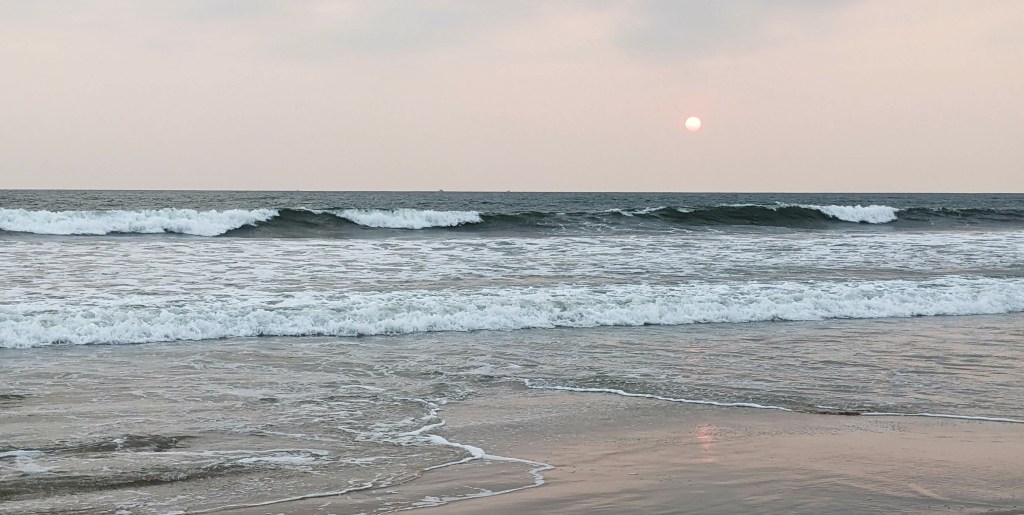
In 2011, the Gulf of Khabhat was selected as a potential site for tidal energy. In 2012, the Gulf of Kutch was set to see large-scale development for tidal energy. The Sundarbans were set to have a 3.75 megawatt tidal energy project. There was also a project to harvest wave energy on the west coast of India. Lakshadweep and the Andaman and Nicobar Islands were slated for projects generating wave and ocean thermal energy. However, none of these projects reached completion. They stalled before actual implementation.
Why?
Gobinath Ravindran, Symbiosis Centre for Research and Innovation, Pune in collaboration with researchers from SR University, Kampala University, PSG College of Technology, and Chandigarh University, set out to investigate.
They extracted all the data on research on the energy of oceans published between 2009 and 2024 to understand the reasons behind the stalling and to conduct a bibliometric and scientometric analysis.
The researchers found that the energy density of the waves is of the order of 20 to70 kilowatts per square meter. Wave energy can be captured using various mechanical devices. These devices can convert 30 to 40% of wave energy.
Tidal energy generates power by harnessing the height differences in tidal ranges. Though the density is only two to six kilowatts per square meter, the conversion efficiency is remarkable: 80–90% of tidal energy can be converted into power.
Underwater turbines can capture and convert the kinetic energy of marine currents into electrical power. The temperature gradient between warm surface seawater and cold deep-sea water can be exploited to drive heat engines.
The temperature difference is more or less constant 24/7. So, it can be used for continuous electricity production. Though its mechanical efficiency for conversion is as low as three to five percent, it offers the highest capacity factor of 80 to 95%.
The osmotic pressure between freshwater and saltwater at river estuaries due to the difference in salt concentration can also be used for electricity generation. It operates at 20–40% efficiency. Its widespread adoption is limited by the current membrane technology.
If the potential for ocean energy is so vast, we must confront the sobering question: why are we not using the power from the sea? After all, India has more than 11,000 kilometres of coastline.
The answer lies in a harsh financial reality: the massive capital expenditure required to move these projects from the drawing board to the seafloor. Unlike solar or wind power, which have seen costs plummet through mass production, ocean energy remains an expensive and specialised frontier.
The initial investment for these technologies starts at a significant premium. For tidal current energy, the most accessible entry point is at roughly $2,500 to $4,000 per kilowatt. Wave energy follows close behind, requiring between $3,000 and $4,500 per kilowatt to capture the erratic power of the surf. The financial outlay becomes even steeper for ocean thermal energy conversion, where the need for massive offshore platforms pushes costs into the $5,000 to $10,000 per kilowatt range. At the far end of the spectrum, the salinity gradient, which requires a high cost of specialised membranes, demands the highest initial investment of all, ranging from $10,000 to a staggering $15,000 per kilowatt.
Moreover, marine environments are among the most hostile environments for infrastructure. Saltwater corrodes metal. Storms and cyclones destroy structures. Marine organisms attach to equipment and damage devices. Maintenance is dangerous, costly, and complex. Building and repairing systems underwater requires advanced technology and specialised labour. These challenges have kept ocean energy development slow and costly.
To overcome these challenges, there has been a lot of research. Who contributed to research in this field? When? And to which countries did they belong?
To track the evolution of research on ocean energy, the researchers grouped research publications into three clusters of years: 2009-204, 2014-2019 and 2019-2024. The research on ocean energy picked up in 2009 and, within five years, there was an increase in publication volume, citation impact, collaborations, and the number of research teams. But, from 2019, the number of publications reduced.
There was also a shift in research domains. Between 2009 and 2014, the focus was on oil, gas, and traditional marine engineering. Between 2014 and 2019, there was a shift toward climate science, sustainability, and renewable energy. And then, there was an intensification of research on advanced materials, nano-energy and environmental engineering.
The University College Cork, Ireland, is the global leader, with nearly 500 publications. China ranks first globally with 4,300 total citations. The US ranks second with 3,000 citations. India holds a moderate, stable impact with 900 citations.
India has a vast shoreline with immense potential for fulfilling our energy needs. And we have the scientific talent to tackle the remaining hurdles in tapping the energy from oceans. This study is perhaps a sign that India is set to take the lead in research and development for meeting the energy needs of the nation from our oceans.
Energy Nexus 21: 100622 ((2026);
DOI: 10.1016/j.nexus.2025.100622
Reported by Nethra Sailesh
Symbiosis Institute of Mass Communication
This report was written as part of an assignment
given to media students in a workshop
at the Symbiosis Institute of Mass Communication, Pune.
We organise training workshops aimed scientists and science faculty,
to improve skills for writing scientific papers, reviews and grant applications.
Training workshops for PhD scholars to help accelerate
the writing of their thesis are also organised periodically.
For details of such workshops, click on the link below:
scienceandmediaworkshops.
 STEAMindiaReports
Leave a comment