The termite, Odontotermes obesus, derives its name from Greek – “Odonto” meaning “toothed” and “obesus” referring to its relatively robust body form. The species has strong mandibles capable of degrading the semi-digested plant material that the termites bring into the colony. They process it to create a conducive substrate for the growth of their crop, the fungus, Termitomyces. This fungus provides a consistent food source for the termite colony.
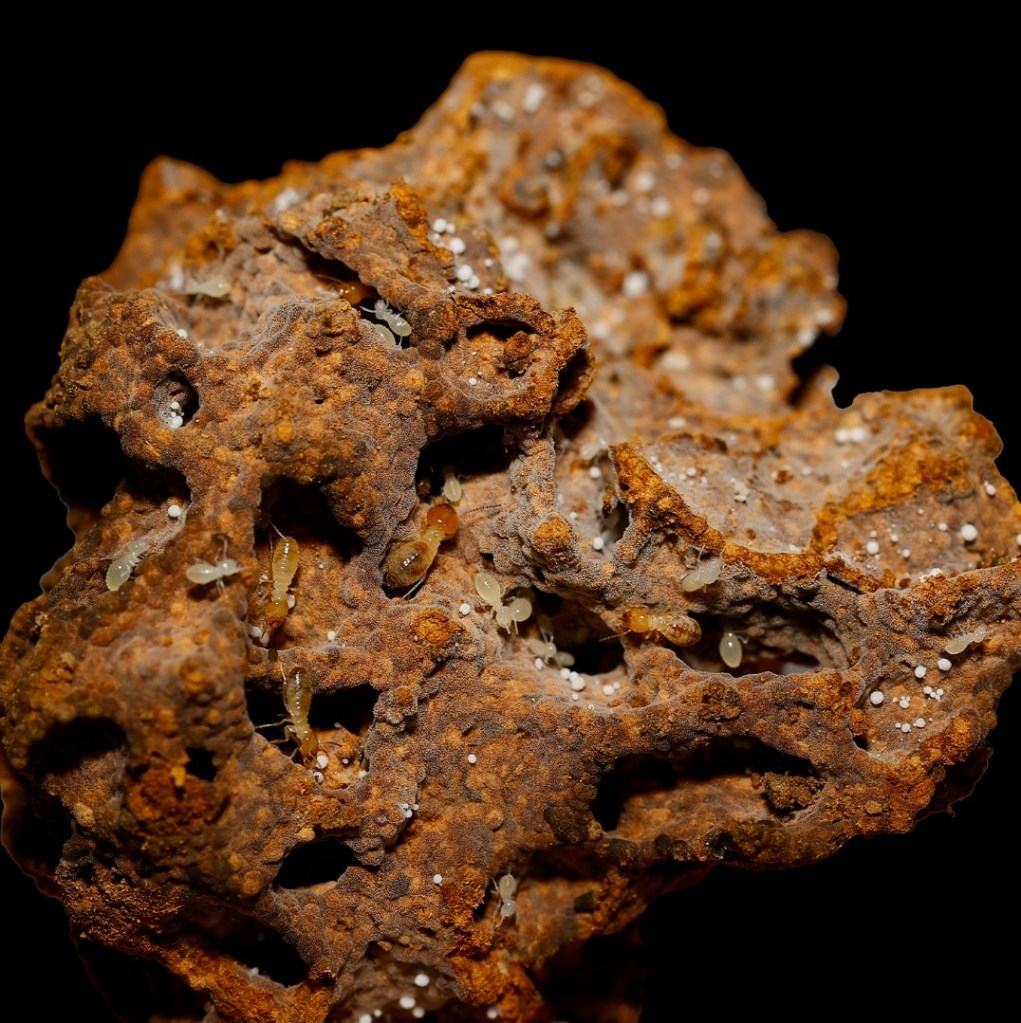
Image: Colony of Odontotermes obesus, courtesy Rhitoban Raychoudhury, IISER Mohali
Pseudoxylaria, a fungus resembling members of the genus Xylaria, can pose a serious threat to the Termitomyces crop. Just like weeds in human agricultural fields, Pseudoxylaria grows fast and can invade the fungus farms.
Experimental removal of termites from their fungus-farms leads to an outbreak of Pseudoxylaria. So somehow, these termites prevent invasion by Pseudoxylaria.
How do they do this?
To find out, Rhitoban Raychoudhury and team, IISER Mohali, along with Ruchira Sen, Sri Guru Gobind Singh College, Chandigarh, collected live termites and fungus combs and started investigating.

They offered the termites pieces of healthy comb and pieces of combs with different levels of Pseudoxylaria infection. When they placed tufts of Pseudoxylaria on the combs, the termites were seen to remove and encase Pseudoxylaria in soil particles. These soil boluses were effective against the fungal infection.
The termites were also seen scraping the area of the fungal contact to remove any further chances of infection. This suggested that the termites can detect initial infections and disinfect the combs before an outbreak can take place.
When the termites were exposed to pieces of naturally infected combs with heavy infestation of Pseudoxylaria, they encased the entire comb or some of its parts with soil boluses. Thus, the termites quarantined the heavily infected combs and confined the weed.

Can they actually distinguish between infected and non-infected parts of combs? To check, the researchers glued an infected piece to a piece of fresh, uninfected comb.
The termites cut and removed the infected piece and encased it with soil boluses and revived the fresh piece of comb. From this, the researchers realised that the termites specifically targeted infected parts of the comb, preventing the infection from spreading to the healthy Termitomyces crop.
Does the soil have fungistatic properties, or are there other factors in the soil boluses?
To investigate, the researchers encased Pseudoxylaria-infected combs with autoclaved soil. But that did not arrest its growth. However, treating the Termitomyces and Pseudoxylaria cultures with a suspension made of soil boluses in phosphate buffer saline inhibited the growth of the fungus. Thus, the researchers confirmed that it is not the soil per se, but something that the termites mix in the soil, that confers the fungistatic property to the soil boluses.
What exactly is the secret behind the fungistatic activity of the soil boluses?
The researchers crushed the heads and entrails of major O. obesus workers, mixed them in phosphate-buffered saline and applied unfiltered extracts of this solution on cultures of Pseudoxylaria. This mixture inhibited the growth of Pseudoxylaria in culture.
When the researchers used filtered extracts of the boluses, there was no inhibition of fungal growth. Therefore, the researchers hypothesised that the secret might be in the microbiome of the soil boluses.
To identify the microbes in the soil boluses, the researchers sequenced the DNA in the boluses. Out of all the fungal sequences identified, Pseudoxylaria accounted for more than 45%, suggesting a negligible role of other fungi in the inhibition of Pseudoxylaria.
Of the thirteen bacterial strains isolated from the soil boluses, four showed inhibitory effects on the growth of Pseudoxylaria
The researchers then combined the isolated bacterial strains with previously identified strains from the same termite mounds to reconstitute a partial bolus microbiome. This combination, when tested against Termitomyces and Pseudoxylaria, inhibited the growth of both fungi in culture. Thus, the researchers demonstrated that fungistatic bacteria in soil boluses are responsible for keeping the termite farms weed-free.
The question now, of course, is whether we can identify the mechanisms by which the bacteria suppress the fungal growth and use them for treating human fungal diseases.
DOI: 10.1126/science.adr2713;
Science, 389 (6767): 1366-1371 (2025)
Reported by Rahul Kumar
Sheodeni Sao College, Kaler
This report was written during a workshop on science writing
organised by scienceandmediaworkshops
to build the capacity of science faculty
to write scientific papers, reviews and project proposals.
A workshop for building the capacity of PhD scholars
to do rigorous research, to write and defend their thesis
will start from 20th of December.
The details can be seen in on this page in scienceandmediaworkshops.
Here is the link to the application form.
 STEAMindiaReports
Leave a comment